Rosehip Oil vs Argan Oil for Skin
Walk into any skincare aisle and two bottles will compete for your attention: rosehip and argan. Both are beloved, both are natural, and both promise glow, hydration, and smoother skin. So when it comes to rosehip oil vs argan oil, which one actually deserves your money? The honest answer is that neither wins outright, because rosehip oil vs argan oil is not a contest between a good oil and a bad one. It is a choice between two different tools, and the right one depends on what your skin needs most right now.
This guide compares rosehip oil vs argan oil properly: their origins, their fatty acid and antioxidant profiles, their textures, their strengths for each skin type, and how to choose, combine, or alternate them. By the end, you should be able to pick with confidence instead of guessing at the shelf.
Rosehip Oil vs Argan Oil: Where Each Oil Comes From
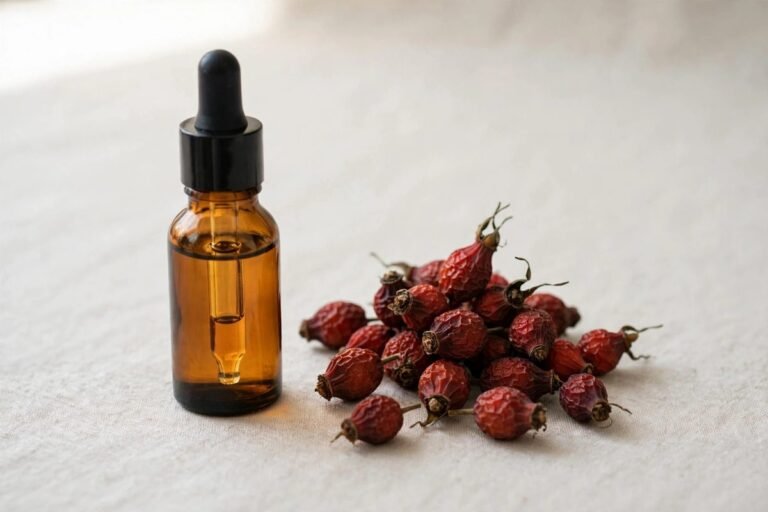
Rosehip oil is cold-pressed from the seeds of wild rose hips, the small red-orange fruits left after roses bloom. It comes mainly from Rosa canina and Rosa rubiginosa plants, and its deep orange-red colour is a clue to its carotenoid content. Argan oil, by contrast, is pressed from the kernels of the argan tree, which grows almost exclusively in Morocco, and it has a lighter golden colour and a faintly nutty scent. Both oils have long traditional histories, rosehip in South American and European folk skincare, argan in Moroccan Berber communities, where it has been used for skin, hair, and cooking for centuries.
Origin matters for shopping as well as for story. In the rosehip oil vs argan oil decision, argan oil carries a higher risk of adulteration because it is expensive and famous, so diluted or blended bottles are common. Rosehip oil is cheaper and less often faked, but refined versions that have lost much of their character are widespread. For both oils, cold-pressed, unrefined, and single-ingredient on the label is the standard to insist on.
Rosehip Oil vs Argan Oil: Fatty Acid Profiles Side by Side
This is the heart of the rosehip oil vs argan oil comparison, and it is the angle most short guides skip over in favour of vague claims about glow. Fatty acids decide how an oil feels, how it supports the barrier, and which skin types it suits, so they are worth understanding in plain language.
Rosehip oil is dominated by polyunsaturated fats. Roughly speaking, its linoleic acid content sits around forty to fifty percent, its alpha-linolenic acid around thirty to thirty-five percent, and its oleic acid much lower, around fourteen to eighteen percent. That high polyunsaturated share is unusual among skincare oils, and it explains a lot: rosehip feels light and dry rather than rich, it absorbs quickly, and it is more fragile, oxidising faster than more stable oils. It also explains why rosehip oil vs argan oil discussions often describe rosehip as the renewal oil, because linoleic acid supports barrier function and the oil’s trace vitamin A activity encourages turnover.
Argan oil has a more balanced profile. Its oleic acid runs around forty-three to forty-nine percent, its linoleic acid around twenty-nine to thirty-six percent, and it contains notable amounts of vitamin E, squalene, and plant sterols that are distinctive to argan. That balance gives argan a silkier, slightly richer feel and better stability, with a shelf life often reaching eighteen to twenty-four months compared with rosehip’s six to twelve. In the rosehip oil vs argan oil debate, argan is the steadier, more protective oil, while rosehip is the lighter, more active one.
Put simply in prose rather than a chart: rosehip brings a flood of linoleic and omega-3 fats that favour renewal and a light finish, while argan brings a balanced oleic and linoleic mix plus exceptional vitamin E that favours comfort, barrier protection, and lasting moisture. Neither profile is better in isolation. The question is always which profile your skin is asking for.
Rosehip Oil vs Argan Oil: Antioxidant Profiles Side by Side
Antioxidants are the second half of the rosehip oil vs argan oil story. Rosehip’s antioxidants lean on carotenoids, the pigments that give it its colour, along with vitamin E and small amounts of vitamin C that degrade fairly quickly after pressing. These compounds help defend against the environmental stress that contributes to dullness and uneven tone, and they complement the oil’s renewal character nicely.
Argan’s antioxidant story is led by vitamin E in unusually high amounts, measured in hundreds of milligrams per kilogram, plus polyphenols and ferulic acid, which support its protective reputation. Squalene, a lipid similar to one skin produces naturally, adds to the comfortable, skin-like feel. Where rosehip oil vs argan oil antioxidant comparisons matter practically is this: argan’s protection is broader and more stable over the bottle’s life, while rosehip’s is tied to freshness, which is another reason to store rosehip cool and dark and replace it promptly if it smells stale.
Rosehip Oil vs Argan Oil: Texture, Absorption, and Finish
Texture is where most people actually feel the rosehip oil vs argan oil difference. Rosehip is light, thin, and fast-absorbing, sinking in within a couple of minutes and leaving a soft, slightly dry finish. Its orange tint can temporarily colour very fair skin if applied heavily, though at normal amounts this is rarely noticeable. Argan is silky and slightly richer, absorbing within a minute or so for many people despite its richer feel, and leaving a smooth, dewy finish that makeup sits well over.
For daytime use under makeup, many people prefer argan’s dewy smoothness or rosehip’s dry finish depending on their skin type: oily skin often likes rosehip’s lighter finish, while dry skin often prefers argan’s dew. For nighttime use, either works, though rosehip’s renewal character makes it a natural evening choice. In the rosehip oil vs argan oil texture contest, there is no winner, only a preference, and trying a small bottle of each is the fastest way to discover yours.
Rosehip Oil vs Argan Oil for Each Skin Type
For dry skin, argan usually wins the rosehip oil vs argan oil question on comfort alone. Its oleic richness and vitamin E feel cushioning, it layers beautifully under cream, and it rarely leaves dry patches feeling tight. Rosehip still helps dry skin, especially for tone, but very dry skin may find it slightly too light on its own and prefer it under a moisturiser.
For oily and combination skin, rosehip often wins the rosehip oil vs argan oil comparison, because its high linoleic content and dry finish suit skin that already produces plenty of its own oil. Argan is not heavy either, and many oily-skinned people use it happily, but rosehip’s lighter touch gives it the edge when shine is a concern.
For acne-prone skin, rosehip oil vs argan oil is a closer call. Rosehip’s linoleic richness and renewal support make it popular for post-acne marks, while argan’s gentle, non-exfoliating character makes it a safe everyday choice that rarely irritates. If active breakouts are the issue, neither oil is a treatment, and our guide to tea tree oil for acne discusses a more targeted option. If marks are the issue, rosehip has the stronger reputation.
For sensitive or reactive skin, argan generally wins the rosehip oil vs argan oil contest for tolerance. It has no retinoid-like activity, so it is less likely to sting or flush reactive skin. Rosehip is still well tolerated by many sensitive people thanks to its short ingredient list, but its trace vitamin A activity means patch testing matters more, and alternating nights is wise if you use other actives.
For mature skin, the rosehip oil vs argan oil answer is often both, at different times. Rosehip supports tone and renewal, argan supports comfort and suppleness, and mature skin frequently wants both qualities. Many people over forty end up using rosehip at night and argan in the morning, which is a perfectly sensible split.
Rosehip Oil vs Argan Oil for Specific Concerns
For uneven tone and dark marks, rosehip oil vs argan oil leans toward rosehip, thanks to its renewal support and carotenoid content. For barrier repair and dryness, it leans toward argan, whose oleic balance and sterols are built for comfort. For fine lines caused by dryness, argan’s plumping moisture often shows faster results, while rosehip’s tone benefits build more slowly. For general glow, both deliver, but in different finishes: rosehip gives a clear, even glow, argan a dewy, nourished one.
For hair, the rosehip oil vs argan oil question shifts, because hair wants weight and slip differently from skin. Argan is the more popular hair oil overall, richer and better at smoothing thick or coarse hair, while rosehip suits fine hair as a light finishing oil. Our guide to argan oil for hair covers the richer option in depth, and our comparison of argan and jojoba oils looks at another popular pairing if you want to explore further.
Rosehip Oil vs Argan Oil: Side Effects and Cautions
Both oils are generally well tolerated, but the rosehip oil vs argan oil safety picture has one important asymmetry. Rosehip’s trace trans-retinoic acid means extra caution is warranted in pregnancy, and anyone expecting should read our guide on whether rosehip oil is safe during pregnancy before deciding. Argan has no such vitamin A connection and is generally considered the lower-caution choice in that situation, though individual advice from a healthcare professional always comes first.
Allergies are possible with either oil, though uncommon. Rosehip comes from the rose family, so people with related plant sensitivities should patch test carefully, and argan comes from a tree nut kernel, so nut-sensitive individuals should test too. A structured patch-test timer routine helps you do that properly for either oil. Shelf life also differs in practice: rosehip goes off noticeably faster, so a stale rosehip bottle is a more common problem than a stale argan one, and any oil that smells sharp or paint-like should be discarded.
Can You Use Rosehip Oil vs Argan Oil Together?
Yes, and this is where the rosehip oil vs argan oil debate often resolves itself. You do not have to choose one forever. Many people blend a drop of each in the palm for a balanced finish, or split them by time of day, rosehip at night for renewal and argan in the morning for comfort and makeup prep. Others split by season, reaching for argan in dry winter months and rosehip in humid summer ones, or split by area, using rosehip on mark-prone cheeks and argan on dry forehead and neck.
Blending is simple: warm one drop of each between your palms and press into damp skin as usual. If you prefer to alternate, use each oil for a few weeks at a time and note how your skin responds, because that kind of personal trial beats any generic verdict, including this one. Our guide to argan oil for skin gives the argan side of the story in full if you want to compare notes, and our comparison of argan versus coconut oil and our comparison of argan versus castor oil extend the picture to other popular oils.
Rosehip Oil vs Argan Oil: Price, Shelf Life, and Value
On price, rosehip usually costs less than genuine argan, partly because argan production is labour-intensive and geographically limited. On value, the picture evens out, because rosehip’s shorter shelf life means you may replace it more often, while argan’s longer stability stretches a bottle further. In the rosehip oil vs argan oil value question, the better buy is the oil you will actually finish before it oxidises, so buy the smaller bottle if you are experimenting and the larger one only once you know your preference.
Storage advice differs slightly too. Both oils belong in dark glass, away from heat and light, but rosehip benefits most from refrigeration in warm homes, while argan is content in a cool cupboard. Treat either bottle’s dropper with clean hands, close it promptly, and trust your nose: fresh oil smells faintly earthy or nutty, stale oil smells sharp and wrong.
How to Decide: Rosehip Oil vs Argan Oil in Five Questions
Ask yourself these five questions and the rosehip oil vs argan oil choice usually answers itself. First, is your main goal fading marks and evening tone, or comfort and deep moisture? Marks point to rosehip, comfort points to argan. Second, is your skin oily, dry, or in between? Oily leans rosehip, dry leans argan. Third, is your skin reactive? Reactive skin usually prefers argan’s gentler profile. Fourth, do you want a dry finish or a dewy one? Dry finish is rosehip, dewy is argan. Fifth, will you use the oil daily and finish the bottle within months? If not, argan’s longer shelf life is a practical advantage.
If your answers split down the middle, that is your answer too: use both, at different times or blended, and stop treating rosehip oil vs argan oil as a rivalry. The best skincare routines are rarely loyal to a single ingredient, and these two oils complement each other so well that owning both is often the most sensible outcome of the comparison.
The Verdict on Rosehip Oil vs Argan Oil
So, rosehip oil vs argan oil, who wins? For renewal, tone, and light finishing, rosehip takes it. For comfort, barrier support, tolerance, and stability, argan takes it. For most real skin, the honest verdict is that the winner is whichever oil matches your current concern, and that concern will change with seasons, age, and skin condition. Start with the oil that matches your biggest concern today, patch test it, give it eight weeks, and then decide whether to stay, switch, or combine.
Whichever you choose, buy pure, cold-pressed oil, store it properly, use sunscreen daily, and judge by your own skin rather than by anyone’s before-and-after photos. That approach serves you better than any single product recommendation, and it is the approach that makes the rosehip oil vs argan oil question genuinely useful instead of just another shopping dilemma.
Frequently Asked Questions About Rosehip Oil vs Argan Oil
Which is better in rosehip oil vs argan oil for dry skin?
For dry skin, argan usually wins the rosehip oil vs argan oil comparison because its richer oleic balance and vitamin E feel more cushioning, though rosehip layered under a cream also works well.
Which is better in rosehip oil vs argan oil for acne scars?
Rosehip generally has the stronger reputation in the rosehip oil vs argan oil debate for post-acne marks, thanks to its renewal support, while argan is the gentler everyday option for sensitive, breakout-prone skin.
Can I mix rosehip oil vs argan oil together?
Yes, blending rosehip oil vs argan oil in the palm is a popular approach, giving you rosehip’s lightness and renewal support with argan’s comfort and stability in a single application.
Is rosehip oil vs argan oil safe during pregnancy?
Argan is generally the lower-caution choice in the rosehip oil vs argan oil comparison during pregnancy, because rosehip contains trace vitamin A compounds. Read our pregnancy safety guide and consult a professional before deciding.