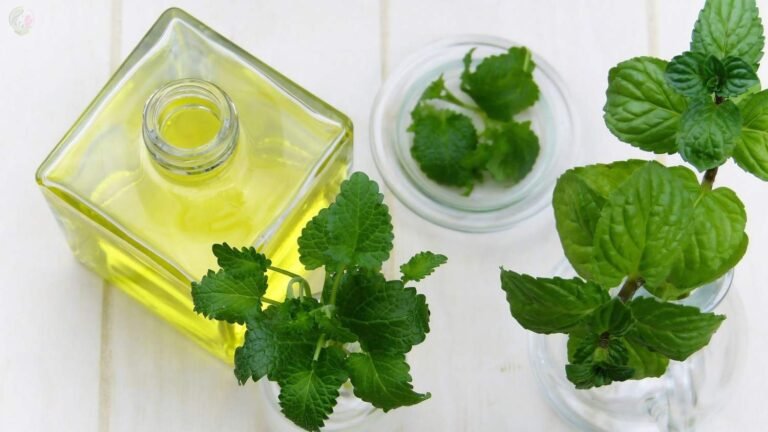
Peppermint Oil vs Rosemary Oil for Hair Growth
When readers search for peppermint oil vs rosemary oil, they usually want a winner. Which oil grows more hair, which one works faster, and which one should you buy if you can only buy one? This guide gives the honest, evidence-based answer to peppermint oil vs rosemary oil, and that answer is more useful than a simple winner: the two oils work through different mechanisms, they have different levels of human evidence, they suit different causes of thinning, and for many people the best choice is not one or the other, but a deliberate combination. By the end, you will know how peppermint oil vs rosemary oil compare on science, safety, scent, cost, timelines, and hair type, and how to choose, or combine, with confidence.
Peppermint Oil vs Rosemary Oil at a Glance
Peppermint oil, distilled from Mentha piperita, is dominated by menthol, which creates a strong cooling tingle and widens blood vessels in the skin. Rosemary oil, distilled from Salvia rosmarinus, formerly Rosmarinus officinalis, is dominated by 1,8-cineole, camphor, and rosmarinic acid, with a herbal, woody scent and a mild warming feel. In the peppermint oil vs rosemary oil comparison, peppermint is the fast, stimulating, circulation-first oil, while rosemary is the slower, protective, follicle-support oil with stronger human trial data. Neither oil creates new follicles. Both aim to help existing follicles stay in their growth phase longer and shed less.
That framing already answers the most common version of peppermint oil vs rosemary oil: if you want the oil with the best human evidence for pattern hair loss, rosemary currently leads. If you want the oil with the fastest scalp sensation, the strongest circulation effect, and the best support for itchy, buildup-prone scalps, peppermint leads. If you want the best overall routine, combining them, at safe total concentrations, often beats choosing one alone, because they address different parts of the hair loss problem at the same time. The sections below unpack each claim so you can judge it yourself.
The Science: Peppermint Oil vs Rosemary Oil Evidence Compared
The evidence gap is the single most important difference in peppermint oil vs rosemary oil. Rosemary oil has a human randomized trial. In a 2015 study published in Skinmed, researchers compared rosemary oil with minoxidil 2 percent in men with androgenetic alopecia, the common pattern hair loss. After six months, both groups showed a significant increase in hair count, with no significant difference between them, and the rosemary group reported less scalp itching than the minoxidil group. That is a real human head-to-head result, in the exact condition most people worry about, over a meaningful timescale. It does not prove rosemary equals minoxidil for everyone, and the study was modest in size, but it is a level of evidence peppermint does not yet have.
Peppermint evidence, by contrast, rests on a well-known 2014 animal study in Toxicological Research, in which peppermint oil outperformed minoxidil 3 percent in mice over four weeks, increasing follicle number, follicle depth, and dermal thickness, with increased growth-factor signaling. That result is striking, but it is a mouse study, not a human trial, and mouse skin and human scalps differ in ways that matter. There is also human mechanistic evidence for peppermint oil vs rosemary oil on the peppermint side: menthol reliably increases human skin blood flow, which is a plausible growth-supporting mechanism. Plausible mechanism plus animal data is encouraging, but it is not equivalent to a human trial. Any article that treats peppermint oil vs rosemary oil as an evidence tie is misleading you.
Rosemary also has laboratory evidence for a mechanism peppermint lacks: inhibition of 5-alpha reductase, the enzyme that converts testosterone to DHT, the hormone that shrinks follicles in pattern hair loss. The laboratory effect is modest and does not equal a drug-level DHT block, but it gives rosemary a plausible protective role in hormone-driven thinning that peppermint, whose main mechanism is vasodilation, does not claim. For a general background on peppermint, see peppermint oil uses and benefits, and for how a rosemary carrier routine is built, see argan and rosemary oil for hair growth.
How Each Oil Works: Peppermint Oil vs Rosemary Oil Mechanisms
In peppermint oil vs rosemary oil, peppermint works mainly through menthol activation of TRPM8 cold receptors and the resulting vasodilation, widening of small blood vessels in the scalp. More blood means more oxygen and nutrients delivered to the follicle base during its energy-hungry growth phase. Peppermint also has antimicrobial and anti-inflammatory properties that help with dandruff, itch, and buildup, all of which disturb follicles. Its effect is fast: the cooling sensation arrives within minutes, and circulation changes are measurable soon after application. That speed is why peppermint feels like it is doing something immediately.
Rosemary works more slowly and on more fronts. Its 1,8-cineole and camphor support circulation, though less dramatically than menthol, while rosmarinic acid and other antioxidants reduce oxidative stress and inflammation around the follicle. Its proposed DHT-related protection, if it holds in humans at scalp doses, would slow the miniaturization process itself, rather than only improving blood supply to a shrinking follicle. In peppermint oil vs rosemary oil terms, peppermint improves the supply lines to the follicle, while rosemary tries to protect the follicle from the hormonal signal that shrinks it. A follicle that is well supplied but still shrinking, and a follicle that is protected but poorly supplied, both underperform. That is the core logic for combining them, developed fully below.
Peppermint Oil vs Rosemary Oil for Different Causes of Thinning
The right answer to peppermint oil vs rosemary oil depends on why your hair is thinning, so start with cause, not with oil. If your thinning follows a pattern, a receding hairline, a thinning crown, or a widening part that runs in your family, the dominant driver is likely DHT sensitivity, and rosemary has the stronger rationale in peppermint oil vs rosemary oil, because of its human pattern-loss trial and its proposed DHT-related mechanism. Peppermint can still help as a circulation supporter, but rosemary should lead the routine.
If your growth slowed after stress, illness, childbirth, heavy product buildup, or a period of poor scalp care, and your scalp feels tight, itchy, or congested, peppermint has the stronger rationale in peppermint oil vs rosemary oil, because circulation, itch, and buildup are its strengths, and the follicles are more likely to be resting than miniaturized. If your main problem is dandruff and itch with shedding as a secondary issue, peppermint again leads, since its cooling and antimicrobial action addresses the itch directly, while rosemary plays a supporting role. If you have both pattern thinning and an itchy, congested scalp, which is common, peppermint oil vs rosemary oil is a false choice, and a combined routine is the honest recommendation.
Peppermint Oil vs Rosemary Oil: Safety and Sensitivity
Safety is the second major difference in peppermint oil vs rosemary oil. Peppermint is the stronger irritant. Its menthol can cause burning, redness, and rash, especially undiluted, at high concentration, on broken skin, or with daily use. Sensitive scalps should start peppermint at 0.5 to 1 percent, patch test carefully, and avoid overnight use until tolerance is proven. Rosemary is generally gentler, with a lower irritation risk at the same concentration, and is often tolerated at 2 to 3 percent where peppermint would sting. That gentleness makes rosemary easier to use consistently, and consistency matters more than intensity in any hair routine.
Both oils must be diluted in a carrier oil, both need patch testing, both should be kept away from the eyes, and neither should be applied to the scalp or face of infants or young children. Peppermint carries an extra caution for young children because menthol can irritate their airways. Pregnant and breastfeeding readers should ask a clinician before using either oil regularly. In peppermint oil vs rosemary oil safety terms, rosemary wins on tolerability, peppermint demands more respect, and that difference alone leads some sensitive-scalp readers to choose rosemary even when peppermint mechanism appeals to them. For carrier choices, see jojoba oil benefits and uses and how to use argan oil for hair.
Peppermint Oil vs Rosemary Oil: Scent, Feel, and Daily Experience
Daily experience decides whether a routine survives past week three, so peppermint oil vs rosemary oil should include scent and feel, not just chemistry. Peppermint smells sharp, fresh, and minty, and feels strongly cooling, even tingling, for 20 to 60 minutes after application. Most people find it invigorating in the morning and refreshing after a workout, but some find the scent too strong for evening use or for sleeping. Rosemary smells herbal, woody, and slightly camphorous, and feels mildly warming or neutral, with no dramatic tingle. It is easier to wear overnight, easier to layer under other products, and less likely to clash with perfume or styling products.
Texture and wash-out also differ slightly, though both depend more on the carrier than on the essential oil. A peppermint blend in jojoba oil feels light and rinses cleanly. A rosemary blend in the same carrier feels similar, so the practical difference is sensation and scent, not greasiness. In peppermint oil vs rosemary oil daily-use terms, choose peppermint if you enjoy a strong sensory signal that confirms application, and choose rosemary if you prefer a quiet, overnight-friendly routine you can forget about. Neither preference is wrong, and both predict adherence better than any laboratory ranking.
Peppermint Oil vs Rosemary Oil: Timelines and What to Expect
Timelines for peppermint oil vs rosemary oil differ because their mechanisms operate on different clocks. Peppermint timelines are faster for scalp comfort: cooling and itch relief within minutes, a cleaner-feeling scalp within one to two weeks, and shedding stabilization potentially by weeks four to eight if circulation and scalp health were the bottleneck. Visible density change from peppermint alone, if it comes, is usually judged at three months. Rosemary timelines are slower and steadier: shedding reduction often reported by weeks four to eight, density improvement by months three to four, and the full comparison in the human trial measured at six months. Rosemary asks for more patience, but its evidence base was measured over that longer window.
That timeline difference leads to a practical rule for peppermint oil vs rosemary oil: do not judge rosemary at four weeks and do not judge peppermint only on its first-week tingle. Judge both at three months with photos of your part line and hairline in consistent light, and judge them on shedding counts as well as appearance. A treatment that reduces shedding without yet adding visible density is still working, because keeping existing hair longer is half the battle in thinning. If neither oil shows any change after three consistent months, the cause of your thinning likely needs medical evaluation rather than a different oil.
Peppermint Oil vs Rosemary Oil by Hair Type and Scalp Type
For fine hair, peppermint oil vs rosemary oil tips toward rosemary for ease of use, because peppermint strong sensation can tempt users into heavy application that weighs fine hair down, while rosemary at 2 percent in a light carrier is easier to rinse clean. For thick and coarse hair, either oil works, and peppermint extra circulation benefit may be welcome through dense hair that is hard to massage thoroughly. For curly and coily hair, types 3 and 4, rosemary gentle profile suits the drier scalps common in these types, while peppermint should be kept at a low concentration in a moisturizing carrier to avoid dryness.
For oily scalps, peppermint oil vs rosemary oil favors peppermint, because its clarifying, cooling action and buildup-clearing massage help oily, congested scalps feel fresher, though daily use should still be avoided to prevent rebound oiliness. For dry scalps, rosemary is usually the safer lead, with peppermint added at a low dose only if itch is a major complaint. For dandruff-prone scalps, peppermint leads on itch relief, as discussed in argan oil for dandruff for the soothing-carrier perspective, while rosemary supports the longer-term follicle picture. For sensitive scalps, rosemary wins clearly in peppermint oil vs rosemary oil, and peppermint should be introduced last, lowest, and with patch testing.
The New Angle: The Two-Clock Model and the Split-Scalp Self-Test
Here is the angle most peppermint oil vs rosemary oil articles miss, and it turns an either-or debate into a testable routine. Think of the two oils as running on two different clocks. Peppermint runs on a fast clock: blood flow, itch relief, and scalp comfort change in minutes to weeks. Rosemary runs on a slow clock: follicle protection and density change in months. Most comparisons fail because they judge both oils on the same clock, declaring peppermint the winner at week two because it tingles, or rosemary the winner at month six because its trial lasted that long. The two-clock model says you should expect different wins at different times, and a routine that only uses one clock will always look incomplete at the other timescale.
The practical payoff of the two-clock model is a split-scalp self-test you can run at home over twelve weeks, an approach no competitor article on peppermint oil vs rosemary oil lays out in usable detail. Divide your scalp down the middle. On the left side, apply a rosemary-only blend, 12 drops per ounce of jojoba oil, two to three times per week. On the right side, apply a peppermint-only blend, 6 drops per ounce of jojoba oil, at the same frequency. Keep everything else identical: same shampoo, same washing frequency, same diet and stress level as far as you can control it. Photograph both sides in the same light every four weeks, and count shedding from each side roughly by noting hair on your pillow and in the drain after side-specific washing if you can separate it, or simply by comparing photos and itch scores per side. At week twelve, you will have personal evidence, not internet opinion, about which clock matters more for your scalp. Most people find one side wins on comfort and the other on density, which is itself the answer: combine them. The split-scalp test in peppermint oil vs rosemary oil replaces guessing with data from the only scalp that matters, yours.
How to Combine Peppermint Oil vs Rosemary Oil into One Routine
Combining resolves peppermint oil vs rosemary oil for most readers, provided the total essential oil concentration stays safe. A balanced combined blend uses 6 drops of rosemary oil and 4 drops of peppermint oil per ounce of carrier oil, about 2 percent total, with jojoba oil as the default carrier. If your scalp is sensitive, use 6 drops of rosemary and 3 drops of peppermint per ounce instead, and if your scalp is oily and tolerant, you may go to 8 drops of rosemary and 5 drops of peppermint per ounce, staying under 3 percent total. Apply to the scalp in sections, massage with fingertips for three to five minutes, leave for 20 to 30 minutes, and wash with lukewarm water, two to three times per week.
An alternative combination strategy is alternating rather than blending: rosemary treatments on two days, peppermint treatments on one day, each at its own comfortable concentration. Alternating suits sensitive scalps, because each oil is used at its ideal dose without competing, and it lets you notice which treatment day leaves your scalp feeling best the next morning. A third strategy is time-of-day splitting: peppermint in the morning for its refreshing effect, rosemary overnight for its gentle, long-contact profile. Whichever combined version of peppermint oil vs rosemary oil you choose, introduce one oil first for two weeks, then add the second, so any reaction can be traced. For other growth-supporting oils to compare, see argan oil for hair growth and amla oil for hair growth.
Peppermint Oil vs Rosemary Oil: Cost, Availability, and Quality
On cost and availability, peppermint oil vs rosemary oil is close. Both are widely available, inexpensive compared with medicated treatments, and sold by many reputable brands. Peppermint oil is often slightly cheaper because peppermint is a high-yield crop, while rosemary oil prices vary more with origin and quality. Neither price difference is large enough to decide peppermint oil vs rosemary oil on its own. Quality matters more than price for both: choose oil labeled with its botanical name, Mentha piperita for peppermint and Salvia rosmarinus for rosemary, marked 100 percent pure essential oil, with no added fragrance, and from a brand that provides testing information. A cheap fragrance oil that smells minty or herbal is not a substitute and will not deliver the active compounds in a reliable dose.
Carrier oil cost also factors in. Jojoba oil is the most popular carrier for both oils and is moderately priced, while argan oil costs more. A small bottle of essential oil plus a bottle of carrier oil typically lasts several months at two to three treatments per week, making either side of peppermint oil vs rosemary oil, or a combination, one of the lowest-cost hair routines available. That low cost is a genuine advantage, but it should not be mistaken for proof of effectiveness. Low cost and real evidence are separate virtues, and rosemary currently has more of the second while both share the first.
Side Effects Compared: Peppermint Oil vs Rosemary Oil
In peppermint oil vs rosemary oil side effects, peppermint causes more frequent irritation: burning, redness, itching, and rash, usually from high concentration or undiluted use. Rosemary causes irritation less often, but it can still cause contact dermatitis in sensitive people, and its camphor content means it should also be diluted and patch tested. Both oils can trigger headache or nausea in scent-sensitive people if used in a poorly ventilated room or at high concentration, and both should be kept away from the eyes. Neither oil should be ingested for hair growth, and neither should be applied to broken, sunburned, or freshly irritated scalp skin.
People with epilepsy, asthma, or scent sensitivity should ask a clinician before using strong essential oils, including both sides of peppermint oil vs rosemary oil, because strong scents and camphor-related compounds can be triggers for some individuals. People using prescription hair loss treatments should tell their clinician about any essential oil routine, so scalp reactions can be interpreted correctly. If either oil causes persistent rash, swelling, or hair loss in patches, stop both, wash gently, and seek medical review rather than switching from one oil to the other and hoping the reaction was specific to the first.
What About Other Oils in the Peppermint Oil vs Rosemary Oil Debate
Readers comparing peppermint oil vs rosemary oil often wonder where other popular oils fit. Tea tree oil, covered in benefits of tea tree oil, the complete science-backed guide, is stronger for dandruff and scalp microbes than either peppermint or rosemary, but has less growth evidence than rosemary. Lavender oil, in benefits of lavender oil, is gentler and calming, useful for stress-related shedding and evening routines, but again with less growth trial data. Castor oil, in castor oil benefits, uses, and side effects, is a thick carrier rather than a follicle stimulator, and its growth reputation rests mainly on tradition and conditioning, not trials. Argan oil conditions and protects lengths beautifully, as in argan oil for hair growth, but it is not a DHT or circulation treatment. Placing peppermint oil vs rosemary oil in this wider field shows why they are the two most serious essential-oil contenders for growth, and why rosemary human trial still sets it apart.
Decision Guide: Peppermint Oil vs Rosemary Oil for Your Situation
Choose rosemary as your lead oil in peppermint oil vs rosemary oil if your thinning is patterned, gradual, and family-linked, if your scalp is sensitive, if you want the strongest human evidence, or if you prefer a gentle overnight routine. Choose peppermint as your lead oil if your growth slowed after stress, illness, or buildup, if itch and congestion are your main complaints, if your scalp is oily, or if you value a fast, refreshing treatment you can feel working. Choose both, blended or alternated, if you have patterned thinning plus an itchy or congested scalp, if you have tried one oil alone without enough change, or if you want to cover both the fast circulation clock and the slow protection clock at once.
Whichever choice you make from peppermint oil vs rosemary oil, commit to it for three months, use a safe dilution, photograph your progress, and reassess honestly. A routine that you follow consistently at a safe dose beats a theoretically perfect routine that irritates your scalp in week two. And if shedding is sudden, patchy, or accompanied by other symptoms, or if thinning progresses despite three months of careful routine, see a dermatologist. Essential oils support follicles; they do not diagnose the medical causes of hair loss, and early medical assessment preserves options that home care cannot restore later.
Frequently Asked Questions About Peppermint Oil vs Rosemary Oil
Which is better, peppermint oil vs rosemary oil, for hair growth?
For pattern hair loss, rosemary currently has stronger human evidence in peppermint oil vs rosemary oil, thanks to its six-month trial against minoxidil. For circulation, itch, and buildup-related slow growth, peppermint has the stronger mechanism. For most people, combining both covers more causes than either alone.
Can I mix peppermint oil vs rosemary oil together?
Yes. Mixing peppermint oil vs rosemary oil is safe at a total essential oil concentration of 2 to 3 percent, for example 6 drops of rosemary and 4 drops of peppermint per ounce of carrier oil, with patch testing before full use.
Is peppermint oil vs rosemary oil safe for sensitive scalps?
Rosemary is generally gentler in peppermint oil vs rosemary oil comparisons. Sensitive scalps should lead with rosemary, add peppermint last at 0.5 to 1 percent, and patch test each step.
How long until peppermint oil vs rosemary oil shows results?
Scalp comfort from peppermint can improve in weeks, while density change from either oil in peppermint oil vs rosemary oil should be judged at three to six months with photos, not at two weeks.
Can peppermint oil vs rosemary oil replace minoxidil?
No responsible comparison claims that. In peppermint oil vs rosemary oil, rosemary matched minoxidil 2 percent in one modest human trial, but that does not make either oil a proven replacement for prescribed treatment, especially for progressive pattern loss.
Final Verdict on Peppermint Oil vs Rosemary Oil
The final verdict on peppermint oil vs rosemary oil is not a knockout, but a division of labor. Rosemary is the evidence leader for pattern thinning, the gentler daily companion, and the slow-clock protector. Peppermint is the circulation leader, the itch reliever, and the fast-clock stimulator. Used alone, each leaves part of the problem unaddressed. Used together, at safe dilutions, on a consistent two to three times per week schedule, and judged over three to six months with photos, peppermint oil vs rosemary oil stops being a rivalry and becomes a complete routine: peppermint opens blood flow and calms the scalp today, rosemary protects follicles for the months ahead, and your own split-scalp test tells you which clock your hair needed most.