Amla Oil for Grey Hair: What It Can and Cannot Do
If you are researching amla oil for grey hair, you have probably seen two very different kinds of claims. Some articles present it as a natural way to restore your original colour, while others dismiss it as an old wives’ tale with nothing to offer at all. The truth sits in between, and it is less dramatic than either version. Amla oil for grey hair will not turn grey strands back to their original colour, but that does not mean it is useless. Used with realistic expectations, it can support scalp health, improve the condition of greying hair, and in some cases darken its appearance over time. This article explains what amla oil for grey hair can plausibly do, what it cannot do, and how to decide whether it is worth a place in your routine.
Before we go further, one honest statement matters more than anything else in this guide: once a hair follicle stops producing melanin, the pigment that gives hair its colour, no oil applied to the scalp has been shown to switch that production back on in a reliable, lasting way. That includes amla oil for grey hair. Anyone promising reversal is selling hope, not evidence. What follows is therefore not a reversal plan. It is a practical look at support, appearance, and care for hair that is already greying.
Why Hair Turns Grey in the First Place
Each strand of hair gets its colour from melanocytes, pigment-producing cells inside the follicle. As we age, those cells gradually produce less melanin, and eventually some stop altogether. The result is hair that grows in grey, silver, or white. Genetics is the strongest influence on when this starts and how quickly it spreads, which is why some people notice their first grey hairs in their twenties while others keep most of their colour into their fifties. Stress, smoking, nutritional deficiencies, and certain health conditions can be associated with earlier greying, but they are rarely the whole story, and fixing one factor does not usually undo years of pigment loss.
Grey hair is also different in texture, not just colour. Without melanin, the hair shaft can feel coarser, drier, and more wiry, and it often becomes more prone to frizz and breakage. That change in texture is one reason greying hair can be harder to manage, even for people who are perfectly happy with the colour itself. Any routine for greying hair therefore has two jobs: caring for the scalp and follicles that are still producing pigment, and keeping the hair that has already turned grey as soft, strong, and healthy-looking as possible.
How Amla Oil for Grey Hair Is Supposed to Work
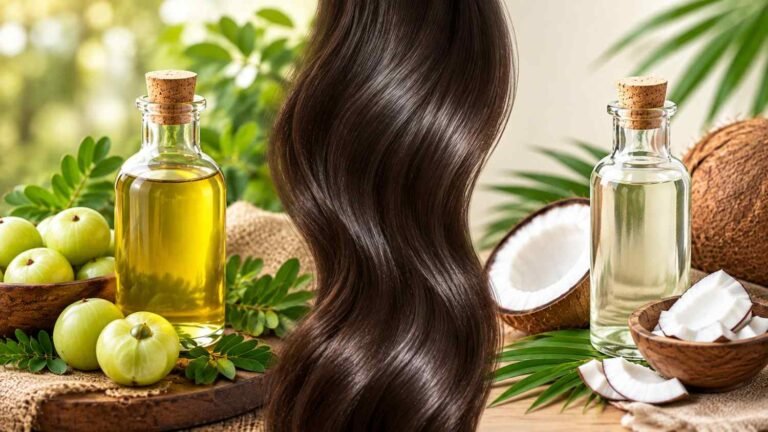
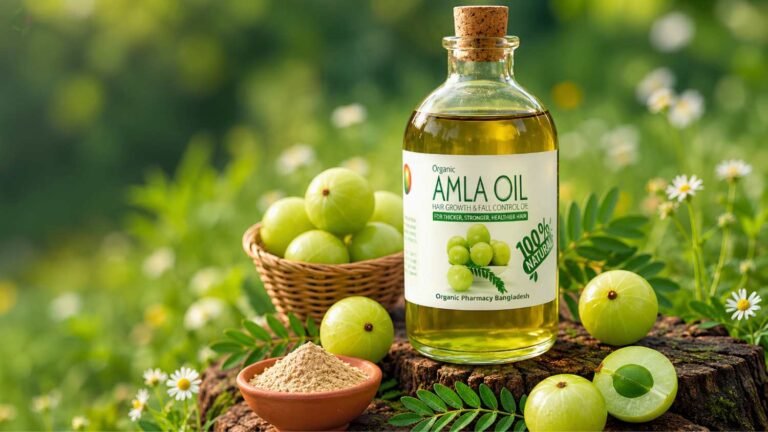
Amla, also known as Indian gooseberry, has been used in Ayurvedic hair care for centuries, and amla oil for grey hair is typically made by infusing the fruit into a carrier oil such as coconut or sesame oil. Traditional use is the strongest part of its story. In Ayurvedic practice, amla has long been associated with scalp nourishment, hair strength, and maintaining dark, healthy-looking hair. That history is worth respecting, but tradition alone is not proof of a specific effect, and it is important to separate the two.
The modern reasoning usually offered for amla oil for grey hair rests on its antioxidant content. Amla fruit is rich in vitamin C and other plant compounds with antioxidant activity, and oxidative stress — damage from unstable molecules that builds up over time — is one of the processes thought to contribute to the decline of melanocytes. The theory, in plain terms, is that reducing oxidative stress around the follicle might help protect the pigment cells that are still working. It is a plausible mechanism, and it is often stated as though it were a proven result. It is not. Laboratory and animal studies on amla extracts are interesting, but they do not prove that rubbing amla oil for grey hair on a human scalp will preserve or restore hair colour, and human trials specifically testing amla oil for grey hair are limited and small.
There is also a simpler, more visible explanation for some of the results people report. Amla oil for grey hair can condition the hair shaft, add shine, and, with repeated use, darken the appearance of hair slightly. That darkening effect is real for some people, but it is not the same as restoring melanin. It is closer to a gradual tinting or staining effect from the oil itself, combined with better-conditioned hair reflecting light differently. Understanding that distinction prevents a lot of disappointment: hair may look darker without any grey strand actually regaining its original pigment from within.
The Greying Timeline: What Amla Plausibly Supports at Each Stage
Most articles treat greying as a single problem with a single answer. In practice, your stage of greying changes what any hair oil can reasonably do for you, and this timeline framing is the most useful way to set expectations. Think of it in three stages: early greying, established greying, and mostly grey hair. Amla oil for grey hair has a different, more modest role at each stage, and recognising your stage helps you judge whether the results you see are actually meaningful.
Early Greying: A Few Strands Here and There
At the early stage, most of your follicles are still producing pigment, and only a scattered few have stopped. This is the stage where scalp care makes the most sense, not because amla oil for grey hair can rescue follicles that have already stopped, but because the overall health of your scalp and hair matters most while the majority of pigment production is still intact. Regular scalp massage with amla oil for grey hair can support circulation to the scalp, keep the scalp moisturised, and help you build a consistent, gentle hair-care routine that avoids harsh treatments and excessive heat. If you also address factors within your control — a balanced diet, not smoking, and managing stress where possible — you are supporting general hair health, even though none of this guarantees that new grey hairs will not appear.
Be wary of any claim that starting amla oil for grey hair at this stage will freeze greying in place. Greying is largely driven by genetics and time, and a few early grey hairs are usually the beginning of a gradual process, not a problem that one product can halt. The honest benefit at this stage is supportive care and possibly a slightly darker, glossier appearance, not prevention in any guaranteed sense.
Established Greying: Noticeable Patches and Streaks
Once greying is established, with visible patches, streaks, or a salt-and-pepper pattern, the realistic role of amla oil for grey hair shifts from pigment support to hair quality. Grey and partially grey hair tends to be drier and coarser, so conditioning becomes the main benefit. Amla oil for grey hair at this stage can help soften wiry texture, reduce frizz, add shine, and make grey strands easier to comb and style. For many people, that improvement in texture and manageability matters more than colour, because well-conditioned grey hair looks intentional and healthy rather than dry and neglected.
At this stage, the darkening effect may also become more noticeable, because there is more grey hair for any tinting effect to act on. Some people welcome this, especially if they are not ready to embrace fully grey hair and want a softer transition. Others may find the effect uneven, since it will show more on lighter strands than on hair that still has pigment. Either way, the effect is cosmetic and gradual, and it washes out or fades if you stop using the oil. It is not a dye, and it will not produce the even, predictable coverage of a proper hair colour product.
Mostly Grey or Fully Grey Hair
When hair is mostly or fully grey, the conversation changes again. At this point, there is very little pigment production left to support, so any talk of preserving colour is largely beside the point. Amla oil for grey hair can still be useful here, but purely as a conditioning and scalp-care oil. It can help with dryness, add softness and shine, and support a healthy scalp, which matters at any age. What it cannot do is restore the colour you had at twenty-five, and anyone suggesting otherwise at this stage is misleading you.
Many people at this stage find that embracing grey hair, with good conditioning and a flattering cut, looks better than chasing a reversal that never arrives. If you love the ritual of oiling and your hair feels better for it, there is no reason to stop. Just judge the oil by what it actually delivers — softer, shinier, better-managed grey hair — rather than by a colour change it was never likely to produce.
Will Amla Oil for Grey Hair Reverse Grey Hair?
The short answer is no, not in the way most people mean when they ask the question. There is no reliable evidence that amla oil for grey hair turns grey strands back to their original colour, and there is no credible mechanism by which an oil applied to the scalp would restart melanin production in follicles where it has permanently stopped. Some before-and-after photos online appear to show dramatic reversals, but these are often explained by lighting, hair dye, henna, the darkening effect described above, or simply by comparing conditioned, darker-looking hair with dry, faded hair in the first photo.
That does not mean every positive report is invented. People who start oiling regularly often improve their overall hair care at the same time: they wash less harshly, use less heat, trim split ends, and eat and sleep better. Their hair genuinely looks healthier, and healthier hair can look darker and richer. The mistake is attributing all of that improvement to a single ingredient reversing greying, when the real story is usually better care plus a mild cosmetic darkening effect.
If a product, article, or seller promises that amla oil for grey hair will reverse grey hair, treat that promise as a red flag. Honest hair care can promise conditioning, scalp support, and improved appearance. It cannot promise to undo a biological process that is largely driven by genetics and ageing.
The Darkening Effect and the Blonde Hair Warning
One practical point is skipped by most articles about amla oil for grey hair, and it matters a great deal if your hair is light in colour. Amla can darken the appearance of hair over time. For people with dark brown or black hair who are greying, that darkening is often welcome, because it can soften the contrast between grey strands and the rest of the hair. For people with blonde or light-coloured hair, the same effect can be unwelcome: repeated use may gradually darken blonde hair, alter its tone, or leave a slightly yellowish or brownish cast that was never intended.
If you have blonde or light-coloured hair, be cautious. Test amla oil for grey hair on a small, hidden section first, use it less frequently than the usual routine, and stop if you notice unwanted darkening. The same caution applies if you have colour-treated light hair, highlights, or bleached sections, where the result can be even less predictable. This warning is not a reason to fear amla oil for grey hair, but it is a reason to test before committing to regular, full-head use, especially when your natural colour is light.
The darkening effect also explains why results vary so much from person to person. Hair porosity, natural colour, how often the oil is used, how long it is left on, and whether other ingredients such as henna are mixed in all influence the outcome. Two people following the same routine can therefore see quite different results, and neither result proves that the oil is reversing greying from within.
How to Use Amla Oil for Grey Hair Safely
If you decide to try amla oil for grey hair, a simple, consistent routine works better than an aggressive one. Start with a patch test: apply a small amount behind your ear or on your inner arm and wait 24 hours to check for irritation or allergy. This step is easy to skip and important not to, because scalp irritation will do far more harm to your hair goals than any benefit the oil might offer. If you have a sensitive scalp, eczema, or psoriasis, talk to a dermatologist before starting any new scalp oil.
For a typical routine, warm a small amount of oil between your palms — never heat it until it is hot — and massage it gently into your scalp with your fingertips for a few minutes. Work any remainder through the lengths of your hair, focusing on dry ends rather than saturating already oily roots. Leave it on for at least 30 minutes, or overnight if your scalp tolerates it and you protect your pillow, then wash with a gentle shampoo. Two to three times a week is a reasonable frequency for most people; daily heavy oiling is not necessary and can leave hair limp or lead to build-up.
Choose a product you can actually verify. Look for a clear ingredient list, a reputable brand, and an oil whose base and amla content are stated rather than hidden behind vague claims. A simple, well-made amla oil for grey hair is preferable to an expensive blend making reversal promises on its label. Store the oil away from heat and sunlight, and discard it if it smells rancid, since oxidised oil will not help your scalp.
Set a fair trial period and a clear way to judge it. Give the routine eight to twelve weeks of consistent use, take photos in the same lighting at the start and at the end, and judge the result by texture, shine, manageability, and scalp comfort — not by counting grey hairs in the hope that some have vanished. If your hair feels softer and looks healthier, the routine is working on the things it can actually influence. If nothing improves, or if irritation appears, there is no obligation to continue.
What Else Actually Helps Greying Hair Look Its Best
Amla oil for grey hair works best as one part of a broader routine, not as a lone solution. Gentle washing matters: harsh, frequent shampooing strips grey hair that is already prone to dryness, so a mild shampoo and a good conditioner usually help more than any single oil. Heat protection matters too, because grey hair can be more fragile, and repeated high heat without protection accelerates breakage and dullness. Regular trims keep split ends from travelling up the shaft and making grey hair look thinner than it is.
Nutrition supports hair health in general, though it is not a reversal treatment either. Severe deficiencies, particularly in vitamin B12, copper, and iron, are associated with premature greying in some cases, and correcting a genuine deficiency with medical guidance can matter. For most people without a deficiency, however, supplements will not restore colour, and high-dose supplements carry their own risks. If you are greying unusually early, losing hair, or noticing other symptoms such as fatigue, it is worth speaking to a clinician rather than self-treating with oils and supplements alone.
Finally, consider whether colour, rather than reversal, is what you actually want. If even, predictable coverage matters to you, a proper hair dye, henna, or a salon colour service will deliver it far more reliably than any oil. There is no contradiction in using amla oil for grey hair while also colouring your hair, provided you follow the colour product’s instructions and give your scalp time to recover between treatments. The goal is hair you feel good about, not loyalty to a single product.
Choosing an Amla Oil: What to Look For
The market for amla oil for grey hair is crowded, and labels vary widely. Some products are pure amla oil for grey hair, while others are blends with many added ingredients, fragrances, or mineral oil. Neither type is automatically better, but you should know which one you are buying. Read the full ingredient list, check whether the product is marketed honestly — conditioning and scalp care, not reversal — and be sceptical of brands that use grey-hair fears to justify a premium price.
If you already use a trusted amla product for general hair care, there is no need to switch to a special “anti-grey” version, which is often the same oil with different marketing. Consistency with a product your scalp tolerates matters more than chasing a new formula every few weeks. Keep your expectations tied to conditioning and appearance, and let the oil earn its place by how your hair feels after a fair trial.
Amla Oil for Grey Hair: A Realistic Verdict
So where does that leave amla oil for grey hair? It is a reasonable, traditional scalp and conditioning oil with a plausible but unproven connection to pigment support, a real but cosmetic darkening effect, and no reliable ability to reverse greying. At early greying, it offers supportive scalp care while most pigment production continues. At established greying, its main value is softer, shinier, more manageable hair and a gentler transition. At mostly grey hair, it remains a useful conditioner, nothing more and nothing less.
That verdict may sound less exciting than a reversal promise, but it is also more useful, because it lets you spend your time and money on things that genuinely improve how your hair looks and feels. Try amla oil for grey hair if you enjoy the ritual, if your scalp tolerates it, and if softer, glossier hair is a result you would value on its own. Skip it, or stop using it, if you are buying it only for a colour reversal, if you have light hair and dislike the darkening risk, or if it irritates your scalp. Grey hair does not need to be fixed to be healthy, and the best routine is the one that keeps it strong, comfortable, and looking the way you want it to look.
Frequently Asked Questions
Does amla oil for grey hair work overnight?
No. Any conditioning benefit builds over weeks of regular use, and the darkening effect, where it occurs, is gradual. Overnight results in advertisements are a sign to be sceptical, not a reason to buy.
Can amla oil for grey hair stop new grey hairs from appearing?
There is no reliable evidence that it can stop new grey hairs. Genetics and ageing drive most greying, and while good scalp care supports general hair health, it does not guarantee that greying will pause.
Is amla oil for grey hair safe for coloured or highlighted hair?
It is generally tolerated, but the darkening effect makes it unpredictable on light, highlighted, or bleached hair. Patch-test a hidden section first and watch for unwanted tone changes before using it across your whole head.
How long should I try amla oil for grey hair before judging it?
Allow eight to twelve weeks of consistent use, two to three times a week, and judge by softness, shine, manageability, and scalp comfort in photos taken in the same lighting. Judging by grey-hair count alone will almost always disappoint, because reversal is not what this oil does.
For a broader overview of amla beyond greying, see our guide to amla oil for hair and the benefits of amla oil in general. If you are weighing different formats, our comparison of amla powder vs amla oil for hair and our look at organic amla oil for hair may help. It is also worth reading about amla oil side effects, hair loss, and allergy before starting any new scalp routine, and learning about the fruit itself in our guide to Indian gooseberry. For context on how amla compares with other oils, see amla oil vs coconut oil and what amla powder is and how it is used.