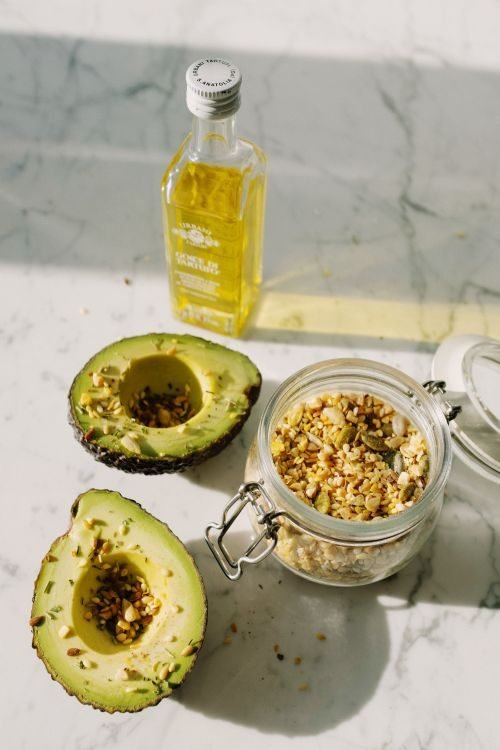
Avocado Oil for Skin
Avocado oil for skin has quietly become one of the most reliable carrier oils in skincare, not because it is fashionable but because it does a straightforward job very well. It moisturises dry skin deeply, supports the skin barrier, calms tightness and flaking, and leaves skin feeling supple rather than greasy, provided you use the right amount for your skin type. If your face feels tight after cleansing, your hands crack in winter, or your usual moisturiser seems to vanish within an hour, avocado oil for skin is worth understanding properly before you buy a bottle.
Avocado oil is pressed from the flesh of the avocado fruit, and it is unusually rich for a plant oil. It is dominated by oleic acid, a monounsaturated fatty acid, with smaller amounts of palmitic and linoleic acids, plus vitamin E, vitamin A in the form of carotenoids, vitamin D, potassium, lecithin and plant sterols such as beta-sitosterol. That nutrient mix is why avocado oil for skin feels richer than lighter oils like grapeseed or jojoba, and why it suits dry and mature skin in particular. It is also why it needs a more careful hand on oily or acne-prone skin, a nuance this guide covers honestly rather than glossing over.
What Avocado Oil for Skin Actually Does
At its core, avocado oil for skin is an emollient. Emollients fill the tiny gaps between skin cells on the surface, smoothing roughness and reducing water loss through the skin barrier. When the barrier is intact, skin holds moisture, feels comfortable, and is less reactive to wind, cold and harsh cleansers. When the barrier is damaged, water escapes, irritants get in, and skin feels tight, itchy or flaky. Avocado oil helps on both fronts: it supplies fats similar to those in the barrier itself, and it forms a breathable layer that slows water loss without sealing the skin completely shut.
That distinction matters. A fully occlusive product, like pure petroleum jelly, blocks water loss almost completely but can feel heavy and trap heat. Avocado oil for skin is occlusive enough to help, but it still absorbs gradually, so skin feels nourished rather than smothered. That balance is why it works well as a night-time facial oil, a body oil after a shower, and a base for homemade balms, and why so many commercial moisturisers list avocado oil among their ingredients rather than relying on it alone.
Benefits of Avocado Oil for Skin
The clearest benefit of avocado oil for skin is deep, lasting moisture for dry skin. Dry skin is not just uncomfortable; it looks dull, makeup sits unevenly on it, and fine lines appear more pronounced when the surface is dehydrated. A few drops of avocado oil pressed into damp skin after cleansing can transform that feeling within days, because damp skin absorbs oil more evenly and the oil then locks in the water already present. People with dry cheeks, dry shins, cracked heels or winter-chapped hands tend to notice the difference fastest.
Barrier support is the second benefit, and it overlaps with the first. Skin that has been over-exfoliated, over-cleansed or exposed to cold wind often feels raw and reactive, and gentle, fragrance-free oils are among the safest ways to support recovery. Avocado oil for skin, used plain and without added fragrance or essential oils, is a good candidate for that recovery phase, because it supplies barrier lipids without the alcohol, fragrance or strong actives that can sting compromised skin. If your skin is currently irritated, however, keep the routine minimal and patch test first, as described later in this guide.
Antioxidant protection is a real but modest benefit. Vitamin E and carotenoids in avocado oil for skin help neutralise free radicals from pollution and everyday environmental exposure, which contribute to premature ageing over time. That does not mean avocado oil reverses wrinkles or replaces sunscreen, and any guide claiming so is overstating the evidence. What it does mean is that a daily moisturising step with antioxidant content is a sensible part of a broader routine, alongside sunscreen during the day and a balanced diet.
Soothing and softening is another genuine strength. Avocado oil for skin can calm the tight, itchy feeling that comes with dryness, soften rough patches on elbows and knees, and make skin feel more flexible and comfortable. Some people also find it helpful for softening the appearance of dry, flaky patches associated with eczema-prone skin, although eczema itself needs proper medical management and avocado oil should be seen as a supportive moisturiser, not a treatment. If you have eczema, psoriasis or another diagnosed skin condition, check with your clinician about whether a plain oil fits your treatment plan.
Finally, avocado oil for skin is useful as a makeup remover and cleansing oil. It dissolves sunscreen, long-wear makeup and daily grime effectively, because oil dissolves oil, and it does so without the stripping feeling that foaming cleansers can leave. Massage a small amount over dry skin, add a little water to emulsify if you like, and rinse or wipe away with a soft cloth, then follow with a gentle cleanser if you prefer a double cleanse. This method suits dry and normal skin especially well, and it is a good way to test whether your skin likes avocado oil before committing to it as a leave-on product.
The Oleic-Acid Nuance: Avocado Oil for Skin and Acne-Prone Skin
Here is the unique angle most guides on avocado oil for skin either skip or get wrong. Avocado oil is rich in oleic acid, and oleic acid behaves differently on different skin types. On dry, mature or barrier-compromised skin, oleic acid is a strength: it is deeply emollient, it softens effectively, and it helps restore the lipid layer that keeps moisture in. On oily or acne-prone skin, however, the picture is more complicated, and honesty about that complication is what separates a useful guide from a sales pitch.
Research on skin lipids has long noted that people with acne-prone skin tend to have lower levels of linoleic acid in their skin oils and relatively higher oleic acid, and that applying more oleic-acid-rich oil can, in some people, feel heavy or contribute to congestion. That does not mean avocado oil for skin causes acne in everyone, and it certainly does not mean it is forbidden for acne-prone skin. It does mean that if you are acne-prone, you should treat avocado oil as a test, not a certainty: patch test on a small area of the jawline for a week, use only two or three drops, prefer it as a short-contact cleansing oil that gets washed off rather than a leave-on night oil, and watch for new congestion before deciding it suits you.
Lighter, linoleic-acid-richer oils such as grapeseed or rosehip are often a better first choice for very oily or acne-prone skin, and jojoba oil, which mimics skin sebum, is another common alternative. Our comparison of shea butter versus coconut oil for skin and hair and our piece on hemp seed oil for cystic acne both wrestle with the same trade-off between richness and congestion, and they are worth reading if you are trying to choose an oil for reactive skin. The key lesson is simple: the richest oil is not automatically the best oil for every face, and matching the oil to your skin type matters more than following a trend.
For combination skin, a middle path works well. Use avocado oil for skin on the dry areas, such as cheeks and the outer face, and skip it or use a lighter oil on the oilier T-zone. Skin is rarely uniform, and treating it as if it were is one of the most common skincare mistakes. A drop on the cheeks and a different product on the forehead is not inconsistency; it is good skincare.
Avocado Oil for Skin on the Face: A Practical Routine
For the face, less is almost always more with avocado oil for skin. Start in the evening, when you do not need to layer sunscreen or makeup over it and the oil has hours to absorb. Cleanse gently, leave the skin slightly damp, warm two to three drops between your fingertips, and press, rather than rub, the oil into the cheeks, forehead and jaw. Pressing distributes the oil more evenly and avoids dragging the skin, which matters especially around the eyes.
If two or three drops feel too rich, mix one drop into your usual moisturiser instead of applying the oil alone. This dilutes the richness while still adding the emollient benefit, and it is often the best compromise for normal or combination skin. If your skin still feels greasy in the morning, you used too much or your skin type prefers a lighter oil, and that is useful information rather than a failure. For daytime use, keep the amount even smaller, let it absorb for ten minutes, and always follow with sunscreen, because avocado oil for skin is not a substitute for sun protection. That sun-protection question is covered separately and in detail in our article on avocado oil and sun protection, so this guide keeps its focus on general skin benefits rather than repeating that angle.
Under makeup, avocado oil for skin can work as a primer for dry skin, but only in a very thin layer and only after it has absorbed. If foundation slides or pills over it, skip the oil in the morning and keep it as a night-time step. For mature skin, the richer finish is often an advantage: it gives a soft, luminous look and helps makeup sit more evenly on drier skin, whereas on younger, oilier skin the same finish can look shiny within an hour.
Avocado Oil for Skin on the Body
The body is where avocado oil for skin is easiest to love, because the skin there is generally less reactive and less prone to congestion than the face. After a warm shower, when the skin is damp and the pores are open, smooth a small amount over the arms, legs and torso, paying attention to elbows, knees, shins and any area that feels tight. The oil absorbs better on damp skin, so you need less of it, and the result lasts longer than applying it to completely dry skin.
For hands, avocado oil for skin is a strong choice, especially for people who wash their hands often or work outdoors. Massage a drop or two into the hands and cuticles at night, and consider cotton gloves for an hour if your hands are very dry, to help the oil absorb rather than transfer to bedding or a phone screen. For feet, the same approach works for cracked heels, with socks worn afterwards, although very cracked or painful heels should be checked by a clinician, because deep cracks can become infected.
For the neck and chest, avocado oil for skin can be used in the same way as on the face, with the same light hand. These areas are often neglected, show dryness early, and respond well to a simple, fragrance-free oil. If you use active skincare products such as retinoids on the neck, apply those first and let them absorb, then use the oil as a sealing step, rather than mixing everything together.
Avocado Oil for Skin Types: Who Benefits Most
Dry skin benefits most from avocado oil for skin, and the benefit is usually obvious within a week of consistent evening use. Mature skin is a close second, because it tends to produce less natural oil with age and loses barrier resilience, so a richer emollient helps restore comfort and softness. Sensitive skin can also benefit, provided the oil is plain, unrefined or gently refined, fragrance-free and patch tested, because a single-ingredient oil has fewer potential irritants than a heavily fragranced cream.
Normal skin can use avocado oil for skin as a seasonal product: in winter, when the air is dry and indoor heating strips moisture, or after travel, sun exposure or illness, when the skin needs extra support. Combination skin benefits from targeted use on dry zones only, as described above. Oily and acne-prone skin should approach with the caution outlined in the oleic-acid section, favouring short-contact use or a lighter oil, and stopping if congestion increases. There is no shame in an oil not suiting your skin; it is information that helps you choose better next time.
Children, pregnant people and those with medical skin conditions should be cautious with any new topical product, including a natural oil. Avocado oil for skin is generally considered gentle, but a patch test is still wise, and any product used on a child or during pregnancy should be discussed with a clinician if there is any doubt. The same applies to skin that is broken, infected or currently being treated with prescription products: do not layer a new oil over a treatment plan without checking first.
Choosing and Storing Avocado Oil for Skin
For skin, look for cold-pressed, unrefined avocado oil with avocado oil as the only ingredient, in a dark glass bottle. Unrefined oil retains more of the nutrients and plant compounds that make avocado oil for skin appealing, and its deep green colour is normal. Refined oil is paler, more neutral in scent and often cheaper, and it is a reasonable choice if you dislike the natural scent or want a lighter feel, but it has been processed more heavily and may have a lower antioxidant content.
Avoid oils with added fragrance, essential oils or preservatives unless you have deliberately chosen a scented blend and patch tested it, because fragrance is one of the most common causes of skin reactions. A plain oil is also easier to troubleshoot: if your skin reacts, you know the oil is the variable, whereas with a blend you cannot tell which ingredient caused the problem. Store the bottle in a cool, dark place, keep the cap closed, and discard it if it develops a sharp, stale or crayon-like smell, which signals rancidity. A smaller bottle used within a few months is better than a large bottle that oxidises over a year.
Avocado oil for skin is also a useful carrier oil for essential oils, but that is a separate skill with its own safety rules. Essential oils must be diluted properly, never applied neat, and some are not suitable for the face at all. If you want to blend, use our essential oil dilution calculator to get the ratio right, and read our guide to essential oil safety before adding anything to a facial oil.
Avocado Oil for Skin: Patch Testing and Safety
Patch testing is simple and worth doing every time you try a new oil. Apply a small amount of avocado oil for skin to the inside of your forearm or behind the ear, leave it for twenty-four to forty-eight hours, and check for redness, itching, bumps or swelling. Our patch-test timer can track that window for you. If you have a known avocado or latex allergy, be especially cautious, because cross-reactivity between avocado and latex is documented, and topical use can still trigger a reaction even if you tolerate eating avocado, or vice versa.
Do not apply avocado oil for skin to broken, infected or severely inflamed skin, and do not use it as a treatment for eczema, psoriasis, dermatitis or fungal infections without clinical advice. Moisturising support is one thing; treatment is another, and confusing the two can delay proper care. If a rash spreads, becomes painful, blisters or does not improve, stop the oil and seek advice rather than trying a stronger product. Finally, keep the oil away from the eyes, and if it gets in, rinse with water and avoid rubbing.
It is also worth comparing avocado oil with other oils you may already use, so you are choosing deliberately rather than accumulating bottles. Our guide to argan oil for skin covers a lighter, faster-absorbing alternative that many combination-skin users prefer, and our piece on amla oil for skin covers a very different oil with its own tradition and profile. Reading those alongside this guide will help you place avocado oil for skin in context instead of treating it as the only option.
Simple Recipes and Everyday Uses for Avocado Oil for Skin
One of the most useful everyday recipes is a simple overnight hand and cuticle treatment. Warm two drops of avocado oil for skin between your fingers, massage it into the nails and cuticles, and leave it to absorb. Over a few weeks, cuticles tend to look softer and less ragged, and the skin around the nails feels less prone to splitting. It is a small ritual, but it is one people actually stick to, which matters more than any elaborate routine.
A body balm is another easy use. Mix avocado oil with a little shea butter, warm them gently until combined, and let the mixture set into a balm. This gives a richer, longer-lasting moisturiser for very dry areas, and it is fully customisable: more oil for a softer balm, more butter for a firmer one. Keep the recipe simple and fragrance-free at first, so you can tell how your skin responds before adding anything else.
For the face, a gentle overnight mask can help in winter. Apply a thin layer of avocado oil for skin after your usual evening moisturiser, as a final sealing step, and rinse in the morning with lukewarm water. This sandwich method, moisturiser first and oil second, is often better tolerated than oil alone, because the moisturiser provides water-based hydration and the oil seals it in. If your skin feels congested the next morning, drop the sealing step and return to moisturiser alone.
Final Thoughts on Avocado Oil for Skin
Avocado oil for skin is at its best when it is used with a clear understanding of what it is: a rich, deeply emollient, nutrient-dense oil that suits dry, mature and sensitive skin beautifully, suits combination skin in targeted areas, and needs caution on oily or acne-prone skin because of its oleic-acid profile. That nuance is not a weakness in the oil; it is the reason a thoughtful guide matters, because the same bottle can be a staple for one person and a poor fit for another, and both outcomes are normal.
Start with a patch test, use a few drops on damp skin in the evening, give it a week or two, and judge it by comfort, softness and whether your skin stays calm. If it works, you have a simple, affordable, single-ingredient product that can cover face, body, hands and cuticles. If it does not, you have learned something specific about your skin type, and a lighter oil may be the better match. Either way, you will have chosen on the basis of your own skin, which is the only test that truly matters.