Lavender Oil for Skin
If you have ever wondered whether lavender oil for skin is a gentle natural remedy or just a pretty smell in a bottle, you are asking the right question. Lavender oil for skin sits in an unusual position: it is one of the most widely used essential oils in skincare, it has genuine anti-inflammatory and antimicrobial properties in laboratory studies, and it is also one of the most common fragrance ingredients people react to. Both facts are true at the same time, and understanding that tension is the key to using it well.
This guide covers what lavender oil for skin can realistically help with, from mild breakouts and redness to dry patches and minor skin irritation, and where it should not be used at all. It gives you safe dilution ratios for the face and body, step-by-step routines for different skin types, and honest warnings about sensitivity, sun exposure, and the difference between true lavender oil and a synthetic fragrance oil that merely smells like lavender. By the end, you should be able to decide whether lavender belongs in your routine, and if it does, how to introduce it without irritating the skin you are trying to soothe.
What Is Lavender Oil for Skin, and Why Do People Use It?
Lavender oil for skin means the essential oil steam-distilled from Lavandula angustifolia flowers, not lavender-scented water, not a dried flower infusion, and not a synthetic fragrance oil. The distinction matters because only true essential oil contains the compounds, mainly linalool and linalyl acetate, that researchers study for skin effects. A product that smells of lavender but lists only fragrance or parfum may contain none of those compounds, and it may contain sensitisers that true lavender oil does not.
People reach for lavender oil for skin for several reasons. Some want a calming ingredient for red, reactive skin. Others hope it will help mild acne, because lavender shows antibacterial activity against acne-associated bacteria in the laboratory. Others use it for dry or flaky patches, for the sting of a minor burn or insect bite, or simply because they enjoy a skincare routine that smells relaxing at night. None of those uses makes lavender a medicine, and none of them means it suits every skin type, but together they explain why lavender has stayed popular for so long.
Our broader overview of the benefits of lavender oil covers its uses beyond skin, including hair and relaxation, while this article focuses on skin alone. If you are new to essential oils, start with our essential oil safety guide as well, because the safety rules in this article assume you already know never to apply an essential oil undiluted.
How Lavender Oil for Skin May Help: Acne, Redness, and Healing
Acne is the most common reason people try lavender oil for skin, and the reasoning is understandable. Lavender’s antimicrobial activity may help reduce the bacteria that contribute to breakouts, while its anti-inflammatory compounds may calm the redness around a spot. In practice, that means lavender works best as a gentle supporting ingredient for mild, occasional breakouts, not as a replacement for proven acne treatments. If you have moderate or severe acne, cystic spots, or acne that leaves scars, a dermatologist’s treatment plan will do far more than any essential oil, and delaying that care can leave permanent marks.
For an occasional spot, a very dilute application can be soothing. Mix one drop of lavender oil into a teaspoon of a light carrier oil such as jojoba, which is non-comedogenic for most people, and dab it only on the spot with a clean fingertip or cotton swab, not across the whole face. Use it once a day at most, and stop if the area becomes more red or itchy. Lavender oil for skin should calm a spot, not sting it, and stinging is a signal to wash it off and dilute further next time, or to stop altogether.
Redness and irritation are another area where lavender earns its reputation. People with skin that flushes easily after washing, shaving, or sun exposure sometimes find a dilute lavender blend calming, particularly in the evening when the skin is resting. The effect is usually modest and temporary, more like a soothing compress than a treatment for an underlying condition. If your redness comes with persistent scaling, blistering, or a known condition such as rosacea or eczema, treat lavender as an experiment to discuss with your clinician, not as a first-line remedy, because even gentle oils can flare reactive skin.
Minor wound healing is the oldest lavender story of all. The French chemist Rene-Maurice Gattefosse famously treated a burn with lavender oil in the early twentieth century, an event often cited as the birth of modern aromatherapy. Modern research supports a modest role: lavender may support the healing of minor superficial skin irritation and help keep the area cleaner, but it should never be applied to open wounds, deep burns, or broken skin. For a small superficial graze that has already closed, a dilute blend may feel soothing, but any wound that is deep, infected, or slow to heal needs proper medical care, not an essential oil.
Lavender Oil for Skin by Skin Type
Oily and combination skin often tolerates lavender oil for skin well, because jojoba and other light carriers do not add heavy grease, and lavender’s scent makes a simple routine feel pleasant rather than clinical. If your T-zone is oily but your cheeks are normal, apply the dilute blend only where you need it rather than coating the whole face. A thin layer in the evening, after cleansing, is usually enough, and you do not need to add it to every product you own. One lavender product used consistently is better than five lavender products layered together, because the total dose is what matters for irritation.
Dry skin benefits from lavender differently. Here the carrier oil does most of the work, sealing in moisture after a shower or after applying a water-based moisturiser, while lavender adds a calming scent and a mild anti-inflammatory effect. Sweet almond oil or argan oil are good carriers for dry skin, and our guide to argan oil for skin explains how that carrier behaves on its own. Apply the blend while skin is still slightly damp, use gentle upward strokes, and avoid scrubbing flaky patches, which only creates more irritation.
Sensitive skin needs the slowest introduction of all. Start with a half-percent dilution, which is about three drops per ounce of carrier oil, and patch test on the inner forearm for a full day before touching your face. Even then, test on a small area of the jawline for several days before using it more widely. Sensitive skin reacts to fragrance as a category, not just to individual oils, and lavender is no exception, however natural it feels. If you have a history of reacting to scented products, that history is more informative than any article, including this one.
Ageing and mature skin is where expectations need the most care. Lavender oil for skin is often marketed with anti-ageing claims about wrinkles and firmness, but there is no good evidence that it reverses wrinkles or rebuilds collagen. What it can do for mature skin is simpler and still valuable: it can make a moisturising routine more pleasant, calm mild redness, and help dry skin feel more comfortable. Those benefits are worth having, but they are not a substitute for sun protection, which remains the single most effective anti-ageing step by a wide margin.
The Unique Angle: Lavender Oil for Skin and Fragrance Sensitivity
Here is the angle most lavender skincare articles avoid: the very reason lavender oil for skin feels so familiar is also the reason it causes problems. Lavender is everywhere, in shampoos, laundry products, candles, and moisturisers, so most people have been exposed to it for years before they ever buy a bottle of essential oil. Repeated low-level exposure is how fragrance sensitivity develops, and once it develops, even a natural oil can trigger it. That means a person who has used lavender-scented products happily for a decade can suddenly react to a concentrated lavender oil, and the reaction is not a sign that the oil was fake or that they did something wrong.
Oxidation makes this worse. When lavender oil ages in a half-empty bottle exposed to heat and light, its compounds change, and oxidised oil is more likely to cause allergic contact dermatitis than fresh oil. This is why a bottle that has sat in a warm bathroom for two years is a different product from the one you bought, even though the label is identical. Buy small bottles, store them cool and dark, keep caps tight, and discard oil that smells sharp, flat, or different from when you opened it. If you react to an old bottle but tolerated a fresh one, oxidation is a likely culprit, and it is worth mentioning to a dermatologist, who can test for specific fragrance allergens.
This also explains why patch testing matters more for lavender than for many other oils. People assume that because lavender is gentle, they can skip the patch test, and that assumption is exactly backwards: a gentle, ubiquitous fragrance is one you are most likely to have been sensitised to without realising it. A patch test timer makes the twenty-four-hour wait easy to track, and the habit will serve you for every essential oil you try in future, not just lavender.
How to Use Lavender Oil for Skin Safely
Safe use of lavender oil for skin comes down to three rules: dilute, patch test, and use less than you think you need. For the face, a one percent dilution is the sensible default, which is about six drops per ounce, or thirty millilitres, of carrier oil. For the body, where skin is thicker, up to two percent is reasonable for short-term use. For sensitive skin, start at half a percent. You can calculate exact drops for any amount of carrier with an essential oil dilution calculator instead of estimating, because drop size varies and small errors matter at these concentrations.
Apply lavender oil for skin in the evening when you are starting out, after cleansing with a gentle product and patting your skin dry. Warm a few drops of the diluted blend between your palms and press it gently onto the skin rather than rubbing vigorously. Avoid the eye area entirely, including eyelids and the skin close to the lash line, and avoid lips and the inside of the nose. If any blend gets into your eyes, rinse with plenty of plain water and seek advice if irritation persists. Wash your hands after applying, so you do not transfer oil to your eyes later without thinking.
Do not apply lavender oil for skin to broken, sunburned, or freshly exfoliated skin, and do not use it immediately after a chemical peel, laser treatment, or strong active ingredient such as a high-strength retinoid or acid, unless your clinician advises it. Skin that is already stressed is more permeable and more reactive, and adding an essential oil at that moment can turn a mild treatment reaction into a lasting irritation. Give your skin a few rest days after intensive treatments, then reintroduce lavender slowly if you wish.
Simple Lavender Oil for Skin Routines
For a calming evening facial oil, mix six drops of lavender oil into an ounce of jojoba oil, shake gently, and store it in a dark glass bottle. After cleansing, press two or three drops onto damp skin, focusing on areas that feel tight or look flushed, and follow with your usual moisturiser if your skin needs extra sealing. Use it three or four evenings a week at first, and increase to nightly only if your skin stays calm for two weeks. If you wear makeup, keep the lavender blend for the evening, because an oil layer under makeup can cause it to slide and can trap heat against the skin during the day.
For the body, a two percent blend in sweet almond oil works well after a shower, when skin is warm and slightly damp. Apply it to arms, legs, and shoulders, avoiding any areas with cuts or rashes, and let it absorb for a few minutes before dressing. This is a pleasant way to enjoy lavender oil for skin without putting a new product on your face, and it is a good first step if you are unsure how your skin will react. A body application that causes no reaction for a week is reassuring, though it does not guarantee that facial skin, which is thinner, will react the same way.
For minor skin discomfort such as an insect bite that has already been cleaned, a single drop of diluted lavender blend dabbed onto the area with a cotton swab can feel cooling and may reduce the urge to scratch. Do not apply it to a bite that is swollen, hot, or spreading, and do not use it on a child’s skin without checking age guidance first. For bites and stings that worsen, or for any bite with an allergic reaction, seek medical advice promptly rather than relying on a home remedy.
What Lavender Oil for Skin Should Not Be Used For
Lavender oil for skin should not be used as a treatment for eczema, psoriasis, rosacea, or dermatitis without clinical guidance. Although lavender has anti-inflammatory properties, those conditions involve immune and barrier dysfunction that an essential oil cannot correct, and fragrance is a known trigger for flare-ups in many people with eczema. Our guide to argan oil for eczema discusses a gentler carrier option for reactive skin, but even that article stresses clinician guidance, and the same caution applies here with greater force.
It should not be used on acne that is moderate, severe, or scarring, as a sunscreen, or as a replacement for prescribed topical medicine. Lavender oil offers no sun protection, and applying oil before sun exposure can increase the risk of irritation and, for some oils, photosensitivity. Lavender itself is not strongly phototoxic, but that is not a reason to skip sunscreen, and it is certainly not a reason to apply oil and then spend time in strong sun. Sun protection remains essential, and our guide to avocado oil and sun protection explains why no oil should be treated as sunscreen.
It should not be swallowed for skin benefits. Some older sources mention internal use, but concentrated essential oil can irritate the digestive tract and interact with medicines, and there is no skin benefit that justifies that risk. Skin benefits, where they exist, come from topical use at low dilution, and internal use belongs only under qualified medical supervision, if at all.
Choosing a Good Lavender Oil for Skin
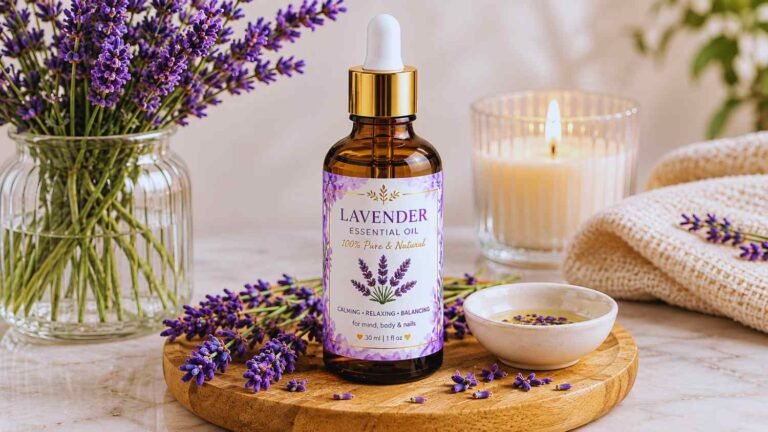
Look for a bottle that names Lavandula angustifolia as the botanical source, states that it is one hundred percent pure essential oil, and gives a steam-distillation method. Avoid products that list fragrance as an ingredient, that are suspiciously cheap for the bottle size, or that promise miracle results. A dark glass bottle, a tight cap, and a batch or expiry date are good signs, and a supplier that provides testing information is better than one that only provides marketing language. Keep the bottle away from bathrooms that get hot and steamy, and prefer a cool bedroom drawer or a skincare fridge shelf.
If you have ever reacted to scented products, consider asking a dermatologist about fragrance patch testing before buying lavender oil for skin. Patch testing can identify specific allergens such as linalool and its oxidised forms, and that knowledge will guide every skincare purchase you make afterwards, not just this one. It is a more useful investment than buying three different lavender brands and testing them on your face one by one.
Frequently Asked Questions About Lavender Oil for Skin
Can I put lavender oil for skin directly on my face?
No. Lavender oil for skin should always be diluted in a carrier oil before facial use, at about one percent for most adults. Undiluted application is the most common cause of irritation, even with lavender, and it increases the risk of developing a lasting sensitivity.
Does lavender oil for skin help acne?
Lavender oil for skin may help mild, occasional spots by calming redness and reducing acne-associated bacteria, but it is not a treatment for moderate or severe acne. If breakouts are frequent, painful, or scarring, see a dermatologist for proven treatment rather than relying on an essential oil.
Is lavender oil for skin safe for sensitive skin?
It can be, at a low dilution and after careful patch testing, but sensitive skin is also the skin most likely to react to fragrance. Start at half a percent, test on the forearm and then the jawline, and stop at the first sign of redness or itching. A reaction does not mean you did something wrong; it means lavender is not right for your skin.
Can lavender oil for skin cause an allergic reaction?
Yes. Lavender is a recognised fragrance allergen, particularly when the oil has oxidised with age, heat, or light exposure. Reactions can include redness, itching, swelling, or a rash that appears hours or days after application. Stop use immediately if any of these occur, and seek advice if the reaction is widespread or does not settle.
Should I use lavender oil for skin in the morning or at night?
Evening use is the safer starting point, because your skin rests overnight, you avoid layering oil under makeup and sunscreen, and you can notice any reaction before going out. Once you know your skin tolerates it, a light morning application is fine, provided you still use sunscreen.
Used thoughtfully, lavender oil for skin can be a pleasant, calming addition to a simple routine. Used carelessly, it can irritate the very skin it was meant to soothe. The difference is almost entirely in the details: a fresh bottle, a low dilution, a patch test, and the honesty to stop when your skin says no. If you keep those details in place, lavender can earn its place on your shelf. If you are also interested in scalp care, our guide to argan and lavender hair mask treatments and our amla oil for skin guide offer useful comparisons, and our hair oil side effects overview covers the broader safety picture for oils used on skin and scalp alike.