How to Remove Semi Permanent Hair Dye Without Bleach
How to Remove Semi Permanent Hair Dye Without Bleach
Learning how to remove semi permanent hair dye without bleach is mostly about order, patience, and knowing when to stop, not about finding one magic ingredient. Semi-permanent dye sits on or just under the surface of the hair rather than changing its structure from inside, which is why it fades with washing and why gentle methods can move it at all. That same surface position is also why it stains unevenly: porous ends grab it harder than healthy roots, vivid blues, greens, and reds cling longer than soft browns, and hair that has been bleached before holds colour in a way virgin hair never does. This guide to how to remove semi permanent hair dye works through a ladder, from the gentlest step to the strongest bleach-free option, with a clear rule for when to move up a rung and when to call a professional instead. Follow the ladder in order, condition after every step, and you will learn how to remove semi permanent hair dye with far less damage than if you reach for the harshest method first.
What Semi Permanent Dye Is, and Why It Fades Unevenly
Semi-permanent dye, sometimes called a direct dye, deposits colour onto the cuticle, the outer layer of the hair shaft, without penetrating deeply into the cortex the way permanent dye does. Because it never locks itself inside the hair in the same way, it washes out gradually, typically over a few weeks of regular washing, although that range is wide and depends on the shade, the porosity of your hair, and how often you wash. Fresh colour fades fastest, because the loosest pigment is still sitting near the surface, while colour that has been on the hair for weeks, or colour applied over bleached or damaged hair, has settled deeper into lifted cuticles and will take longer to shift. That is why two people can use the same method and get different results, and why any guide that promises complete removal in a day should be read with care. Fading in a day is sometimes possible for fresh, light colour on healthy hair. Complete removal in a day, especially for vivid fashion colours on porous hair, is not something you should count on.
Porosity is the hidden variable in how to remove semi permanent hair dye, and it explains why the same method works differently on different heads. Healthy, low-porosity hair has a smooth, closed cuticle that lets go of surface colour fairly readily. Damaged or bleached hair has a raised, open cuticle that traps pigment in its gaps, which is why ends often stay coloured long after roots have faded back to normal. Warm water opens the cuticle slightly and speeds fading, which is useful in a controlled wash but also the reason hot showers alone will slowly wash semi-permanent colour away whether you want them to or not. Knowing your porosity also tells you how careful to be: the more damaged your hair, the gentler your ladder should be, and the more important the conditioning step after each rung becomes.
The First Rule Before Anything Else: Strand Test and Stop Signals
Before you apply any method for how to remove semi permanent hair dye to your full head, test it on a thin, hidden section near the nape of your neck, using the same amount and timing you plan to use everywhere else. A strand test tells you three things no article can: how much colour this method actually lifts on your hair, whether it leaves the strand dry, rough, or gummy, and whether it fades evenly or in patches. If the strand comes out patchy, stop and reconsider, because the same patchiness on your full head will be far harder to fix than it is to prevent. If the strand feels gummy when wet, or if your scalp turns red, itchy, or sore, stop immediately and do not push through with a stronger method. Those are signals that the hair or scalp needs a professional, not another round of home treatment, and ignoring them is how a colour problem becomes a damage problem.
Conditioning after every step of how to remove semi permanent hair dye is not optional decoration, it is part of the method. Every fading technique works by opening the cuticle or loosening pigment, and every one of them leaves the hair drier than it found it. A deep conditioner or a rich mask after each session, and a light sealing oil on the ends once the hair is damp, will do more for the final look than an extra round of fading ever will. If you are learning how to remove semi permanent hair dye because a colour went wrong, remember that the goal is hair that looks good afterwards, not hair that is colour-free but broken. Pace yourself, leave at least a day or two between stronger sessions, and judge the result in daylight after the hair is dry, not while it is wet and still darkened by water.
How to Remove Semi Permanent Hair Dye: The Ladder in Order
Working through how to remove semi permanent hair dye in order matters more than any single product, because each step prepares the hair for the next one and each step costs a little moisture. Start gentle, judge the result after conditioning, and only move up when the previous step has genuinely stalled.
Step One: Clarifying Shampoo and Warm Water
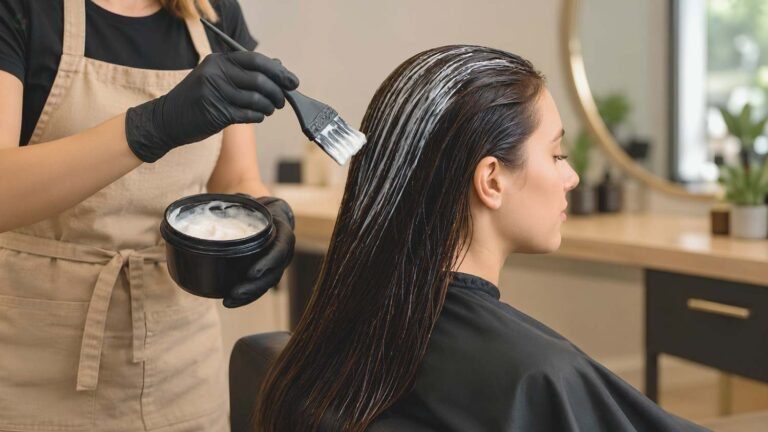
Start how to remove semi permanent hair dye with the gentlest rung, because it is the one you can repeat safely and because fresh colour often responds to it alone. Swap your colour-safe shampoo for a clarifying formula, wet the hair with warm, not scalding, water, work the shampoo through, and let it sit for three to five minutes before rinsing. Warm water opens the cuticle slightly, and the stronger surfactants in a clarifying shampoo lift surface pigment that a gentle shampoo leaves behind. Wash two or three times in one session if the colour is fresh, pressing a white towel against the hair after each round: less colour transfer onto the towel means the method is working. Anti-dandruff shampoos containing zinc pyrithione or selenium sulfide work in a similar way for some people, because they are also stronger cleansers than everyday shampoos, but they are not a separate miracle, they are the same principle with a different bottle.
Expect this step in how to remove semi permanent hair dye to fade rather than erase, which is how to remove semi permanent hair dye safely works: fading first, erasing only if needed. Over a week of regular clarifying washes, a soft semi-permanent shade on healthy hair can fade dramatically, while a vivid shade on porous hair may only soften. That is a successful result, not a failure, because you have moved colour without damage and you now know exactly how stubborn the remaining pigment is. If the clarifying step alone gets you where you want to be, stop there. There is no prize for using a stronger method than you needed, and every stronger rung costs moisture that you will have to put back afterwards.
Step Two: Vitamin C Paste
If clarifying shampoo stalls, the next rung in how to remove semi permanent hair dye is a vitamin C paste, one of the most widely used bleach-free options, and one with a sensible mechanism behind it. Crushed vitamin C, which is ascorbic acid, is mildly acidic, and that acidity helps loosen the bonds holding direct dye molecules to the hair shaft so they rinse away more easily. Crush plain, non-chewable vitamin C tablets into a fine powder, mix them with clarifying shampoo until you have a spreadable paste, apply it evenly to damp hair, and leave it for around thirty minutes before rinsing thoroughly and conditioning. Some guides suggest up to an hour for stubborn colour, but longer is not automatically better, and a strand test will tell you whether your hair tolerates the longer time without turning rough.
Vitamin C paste, in how to remove semi permanent hair dye, works best as a second rung, and knowing how to remove semi permanent hair dye means knowing when that rung has done enough. It works well on fresh and mid-age semi-permanent colour, and it is kinder than the alkaline methods further up the ladder, but it is not free of cost. It can dry the hair, especially with repeated use, and it can fade unevenly if it is applied unevenly, so work in sections and keep the paste off the scalp as much as you can. Leave at least forty-eight hours between vitamin C sessions, and judge the result after conditioning and drying, because wet hair always looks darker than it really is. If one session lifts a satisfying amount of colour, you may need only one more, spaced out, rather than a marathon of back-to-back treatments.
Step Three: Baking Soda with Shampoo, Used with Care
When you use baking soda for how to remove semi permanent hair dye, remember it is alkaline in action: sodium bicarbonate, with a pH around 8 to 9, and that alkalinity swells the cuticle and loosens surface pigment so a shampoo can wash it away. That is why a baking soda paste is often described as effective for semi-permanent dyes, and also why it needs more caution than the steps above it. Mix a small amount, roughly two tablespoons of baking soda with two tablespoons of clarifying shampoo and a tablespoon of deep conditioner to buffer the dryness, massage it through damp hair focusing on the most saturated sections, leave it for ten to fifteen minutes, and rinse thoroughly with lukewarm water. Follow it with an acidic rinse, such as diluted apple cider vinegar, or a low-pH mask, because the alkaline step raises the cuticle and the acidic step helps settle it back down.
Use this rung of how to remove semi permanent hair dye sparingly, once at most in a given week, and never as a daily routine. Repeated alkaline treatment raises cuticle friction, leaves hair feeling rough and tangled, and can make the very porosity problem that trapped the dye in the first place even worse. If your hair is already damaged, bleached, or gummy when wet, skip this rung entirely and move to a dedicated colour remover or a professional instead. The question in how to remove semi permanent hair dye is never whether a method can lift colour, it is whether it can lift colour at a price your hair can afford, and for fragile hair, baking soda’s price is too high.
Step Four: Dish Soap, Hot Oil, and Other Strong Home Options
Dish soap appears in many guides to how to remove semi permanent hair dye, but in how to remove semi permanent hair dye it is a one-off step, not a routine. Because its grease-cutting surfactants do lift fresh direct dye, especially when the colour is only a few washes old. Mixed with warm water and massaged through wet hair for a few minutes, it can shift colour that shampoo alone left behind. Treat it as a one-off, targeted step, not as a shampoo replacement, because it is formulated for dishes, not for scalps, and it strips natural oils aggressively. Follow it immediately with a deep conditioner, and do not repeat it daily. If your scalp is sensitive, or your hair is already dry, this is another rung to skip.
A hot oil treatment, as a step in how to remove semi permanent hair dye, works in the opposite direction and suits a different situation. Warm oil, applied to the hair and left under a shower cap for twenty to thirty minutes, can help loosen surface pigment while adding moisture back at the same time, which makes it a gentler option for dry hair that cannot afford another stripping step. It will not erase vivid colour on its own, but it can soften it noticeably, and it pairs well with the clarifying step, oil first to loosen and moisturise, then a clarifying wash to carry the loosened pigment away. For a fuller picture of oiling as care rather than as fading, our guide to fixing frizzy hair and our hair mask for dry, damaged and frizzy hair explain how to rebuild moisture after any colour work.
Step Five: A Dedicated Bleach-Free Colour Remover
When home mixtures stall in how to remove semi permanent hair dye, a dedicated direct-dye colour remover is the strongest bleach-free option, and for stubborn colour it is often the most controlled one. These formulas are designed to target artificial pigment, breaking down dye molecules so they rinse away, without the lifting action of bleach, and most are ammonia-free as well. Follow the product’s own instructions exactly, including its timing and whether it allows a second application, because different removers work differently and generic advice cannot replace the label. Do a strand test first, even with a commercial product, work in a ventilated room, and condition deeply afterwards, because even a bleach-free remover leaves hair drier than it found it. Very saturated blues and greens may need a second application, and only repeat if the instructions allow it and your strand test still looks healthy.
A dedicated remover in how to remove semi permanent hair dye also has a limit worth respecting. It removes artificial pigment, but it does not restore hair to a virgin state, and it does not fix damage that was already there. If the hair underneath the dye was bleached before, the remover may reveal that lighter, possibly uneven base, which can look like a new problem when it is really an old one coming into view. Plan for that possibility by having a toner or a follow-up shade in mind, or by talking to a colourist before you remove, especially if you intend to recolour soon afterwards. Removing colour and recolouring in the same weekend, without a conditioning gap, is one of the fastest routes to breakage.
Colour-Specific Expectations: Blue, Green, Red, and Dark Shades
Not all semi-permanent colours fade alike, and knowing that in advance prevents a lot of frustration when learning how to remove semi permanent hair dye. Blues and greens are famously stubborn, because their pigment molecules are large and they stain porous hair deeply, and they often fade through teal or muddy stages before they disappear. Reds and coppers also cling, though they tend to fade warmer and more evenly than blues. Dark browns and blacks, even in semi-permanent form, can leave a shadow on light or bleached hair that looks like a stain long after the main colour has gone. Pastel shades, by contrast, often fade fastest, because there was less pigment to begin with, and soft pinks and lavenders may wash out almost entirely with clarifying washes alone.
That difference matters for your ladder in how to remove semi permanent hair dye, and for how to remove semi permanent hair dye on vivid shades most of all. For a pastel or a soft brown, stop at the clarifying and vitamin C rungs and be patient. For a vivid blue or green, expect to need a dedicated remover, expect intermediate stages, and expect the process to take days rather than an afternoon. For a dark shade on bleached hair, accept that a faint shadow may remain even after a remover, and plan your next shade around it rather than chasing a perfectly clean base with repeated stripping. Patience here is not just a virtue, it is the difference between hair that survives the correction and hair that does not.
How to Remove Semi Permanent Hair Dye Without Making It Worse
A short list of mistakes covers most of the damage people do while learning how to remove semi permanent hair dye, and avoiding them matters as much as any method. Do not reach for bleach first, and do not use bleach on hair that is already damaged, gummy, or breaking, because bleach lifts natural pigment as well as artificial colour and it will not distinguish between the two. Do not repeat alkaline or dish-soap treatments daily, because the cuticle damage accumulates faster than the colour fades. Do not apply a new permanent dye directly over a semi-permanent colour you have only half removed, because the remaining pigment will mix with the new shade in unpredictable ways, often towards muddy or green tones. Do not skip conditioning, do not judge the result on wet hair, and do not work through scalp pain, redness, or chemical burns in the hope that the colour will be worth it. Stop, rinse, condition, and get professional advice if any of those appear.
When to Call a Professional Instead
There are situations where the honest answer to how to remove semi permanent hair dye is to book a colourist. Call one if your hair feels gummy or stretches and snaps when wet, if your scalp stays red or sore after a treatment, if the colour is patchy in a way that home methods keep making worse, if you need to go significantly lighter afterwards, or if the hair underneath was bleached and you do not know what base a remover will reveal. A colourist can assess porosity zone by zone, choose a remover and toner combination that a home kit cannot, and correct uneven fading without adding another layer of damage. That is not a failure of home care, it is the point at which home care has done its job and professional tools are the safer next step. Bring photos of the colour before removal, tell them exactly which methods you already tried and when, and let them see the hair dry and in daylight.
Aftercare: Repairing Hair After Colour Removal
Aftercare, after how to remove semi permanent hair dye, is where a removal succeeds or fails in the long run, because hair that has been through several fading sessions is, by definition, hair that has lost moisture and cuticle smoothness. For the first two weeks after removal, wash less often and more gently, use lukewarm rather than hot water, and use a deep mask once or twice a week rather than a light conditioner alone. A small amount of a light sealing oil on damp ends helps lock in the moisture the mask provides, and it is worth choosing that oil for your hair type rather than grabbing the heaviest oil on the shelf. Our argan oil for different hair types guide and our benefits of argan oil guide explain how a light oil fits into a repair routine, and our hair oils vs leave-in conditioner comparison helps you decide whether an oil, a leave-in, or both earns a place in yours. Avoid heat styling for a few days if you can, and when you do use heat, use a protectant and the lowest temperature that does the job.
Re-colouring, after how to remove semi permanent hair dye, deserves its own pause. Give the hair at least a week of conditioning before you put new colour on it, and if you are re-colouring with a permanent dye, tell your colourist what you removed and how, because residual semi-permanent pigment can still influence the new result. A strand test for the new colour is just as important as the strand test for removal was. Hair that has been faded, conditioned, and then re-coloured with a plan will look better and last longer than hair that was stripped and re-coloured in a single frantic weekend.
Frequently Asked Questions
How long does it take to remove semi permanent hair dye?
How to remove semi permanent hair dye takes a time that depends on the shade, the porosity of your hair, and how fresh the colour is. Soft shades on healthy hair can fade dramatically within a week of clarifying washes. Vivid blues, greens, and reds on porous or bleached hair can take several weeks, a dedicated remover, or professional help. How to remove semi permanent hair dye is therefore better thought of as a process measured in washes and sessions, not as a single afternoon task.
Can I remove semi permanent hair dye in one day?
Sometimes, in how to remove semi permanent hair dye, a day of clarifying washes and a vitamin C treatment can fade colour a great deal, but complete removal in one day is not guaranteed, especially for vivid or older colour. If a guide promises it for every shade and every hair type, treat that promise with suspicion, and do not damage your hair trying to force a result the guide oversold.
Does vitamin C damage hair?
Used occasionally and followed by conditioning, a vitamin C paste in how to remove semi permanent hair dye is gentler than alkaline or bleach methods, but it can still dry the hair, especially with repeated use. Space sessions at least forty-eight hours apart, keep the paste off the scalp where possible, and stop if the hair feels rough or gummy. Gentler does not mean free of cost.
Will baking soda remove semi permanent dye completely?
Baking soda, in how to remove semi permanent hair dye, can lift surface pigment, but it is alkaline and drying, and it rarely removes vivid or deeply settled colour completely on its own. Use it sparingly, buffer it with conditioner, follow it with an acidic rinse or a low-pH mask, and skip it entirely if your hair is damaged or bleached. For stubborn colour, a dedicated bleach-free remover is usually the safer stronger step.
Should I bleach semi permanent dye out?
Only as a last resort in how to remove semi permanent hair dye, and ideally only with professional help, because how to remove semi permanent hair dye safely stops short of bleach. Bleach lifts natural pigment as well as artificial colour, it adds damage on top of whatever fading has already cost, and on already damaged hair it can cause breakage. Work through the bleach-free ladder first, and if that stalls, ask a colourist whether bleach, a remover, or a corrective shade is the right next step for your hair.
The Bottom Line
How to remove semi permanent hair dye without bleach comes down to a ladder, not a trick: clarifying shampoo first, vitamin C paste next, baking soda only with care, dish soap and hot oil only as targeted steps, and a dedicated bleach-free remover for stubborn colour, with conditioning after every rung and a strand test before every new method. Expect vivid blues, greens, and reds to take longer, expect a shadow on previously bleached hair, and call a professional when the hair or scalp tells you to stop. Remove with patience, repair with masks and gentle washing, and give the hair a conditioning gap before you colour again, and the correction will leave you with hair that looks good, not just hair that is colour-free.