Jojoba Oil for Curly Hair: Benefits, Curl Types & How to Use It
If you have spent any time trying to make curls behave, you already know the frustrating part is not finding an oil, it is finding the right amount in the right order. That is exactly where jojoba oil for curly hair earns its place. It is not the heaviest oil on the shelf, it is not the glossiest, and it will not turn straight hair curly or loose waves into tight ringlets. What it does, when you use it properly, is seal in the moisture your curls already have, smooth the cuticle so frizz softens, and add a light, flexible shine that does not collapse the pattern underneath.
Most curly hair advice treats all oils as interchangeable, and that is why so many people give up on jojoba oil for curly hair after one greasy wash day. They use a pump instead of drops, they put it on dry hair and wonder why it sits there, or they layer it after a heavy leave-in and end up with stringy, weighed-down curls by lunchtime. The fix is not a different product. It is a dose map matched to your curl type and a sealing order matched to your porosity. Get those two things right, and jojoba oil for curly hair becomes one of the most forgiving oils you can own, especially if your curls are fine, easily weighed down, or prone to frizz in humidity.
This guide stays focused on that practical question. You will learn why jojoba oil for curly hair behaves differently from coconut or argan oil, how many drops to use for 2A waves through 4C coils, when to apply it on damp hair and when to leave it alone, and what to do when your curls are high porosity, low porosity, fine, thick, or somewhere in between. If you want the broader background on the oil itself, our general guide to jojoba oil benefits and uses covers its history, skin uses, and composition in more detail. Here, we stay on curls.
Why Jojoba Oil for Curly Hair Works Differently Than Most Oils
Jojoba oil for curly hair is not really an oil at all, at least not in the way coconut or olive oil are oils. Chemically, it is a liquid wax ester, made mostly of long-chain fatty acids and fatty alcohols joined together. That structure matters more than the marketing on the bottle, because it is very close to human sebum, the natural oil your scalp makes to protect hair and skin. Your scalp recognises it, your hair tolerates it well, and it spreads in a thin, even film instead of pooling in heavy patches.
For curls, that thin film is the whole point. Curly hair is drier than straight hair by design. Each bend in the strand is a place where the cuticle lifts slightly and moisture escapes more easily, and sebum from the scalp has a longer, twistier journey to reach the ends. That is why the ends of curly hair so often feel rough while the roots feel fine, and why a heavy oil can make the roots look greasy while the ends still feel dry. Jojoba oil for curly hair works because it mimics that missing sebum without adding the weight of a true triglyceride oil. It coats, it smooths, and it slows water loss, but it does not try to soak deep into the cortex the way coconut oil does.
That last distinction is worth pausing on. Coconut oil can penetrate the hair shaft because its molecules are small and straight. Jojoba oil for curly hair cannot do that in the same way, and you should not expect it to. Its job is on the surface, sealing and smoothing. Used on damp hair, that surface seal locks in the water you have just added in the shower or with a leave-in. Used on dry hair, there is very little water to lock in, so the same drops just sit on top and look oily. The oil has not changed. The order has.
There is also a texture reason jojoba oil for curly hair suits curls. It is light, non-greasy when used in drops, and it does not solidify at room temperature or leave a waxy build-up as quickly as some butters do. People with fine 2A and 2B waves often find heavier oils impossible, even in small amounts, while jojoba oil for curly hair, used sparingly, gives them shine and frizz control without flattening the wave. People with thick 3C and 4A coils, on the other hand, often need more product overall, but they still benefit from jojoba oil for curly hair because it layers cleanly under or over a cream without pilling or turning white. It is not a miracle worker, and anyone who tells you jojoba oil for curly hair will define your curl pattern on its own is overselling it. Definition comes from your natural pattern, from water, and from styling. Jojoba oil for curly hair helps you keep the definition you already have.
It also tends to be gentle on the scalp, which matters for curly routines that involve scalp oiling, protective styles, or longer gaps between washes. A few drops massaged into the scalp can help soften dry flakes and reduce that tight, itchy feeling without clogging the scalp the way a very heavy oil sometimes does. If you have a sensitive scalp, patch-test first, as you would with any new product, and keep the amount small. A little goes a long way here, and that is a theme you will see again and again in this guide.
The Curl-Type Dose Map for Jojoba Oil for Curly Hair
Here is the part no generic guide gives you, and the part that changes results the fastest: the dose depends on your curl type, not on the size of the bottle or the amount your friend uses. Jojoba oil for curly hair is a drops-not-pumps product, and the difference between two drops and six drops is the difference between soft, defined curls and limp, separated strands that need washing again.
If your curls are fine and loose, in the 2A to 3A range, start with one to two drops, ends only. That is the whole dose for most wash days. Warm the drops between your palms until your hands feel just barely slick, not wet, then smooth them over the very ends, where dryness and frizz show first. Do not rake it through from root to tip, and do not add a second handful because the first did not feel like enough. Fine curls have less hair mass to absorb oil, and the cuticle is usually smoother, so extra oil has nowhere to go except onto the surface, where it weighs the wave down and makes it look stringy. If your ends still feel dry after one to two drops, the answer is usually more water or leave-in underneath, not more oil on top. Add moisture first, then seal it.
If your curls are medium, in the 3B to 3C range, the usual dose is two to four drops, worked from mid-lengths to ends. This is the middle ground where most people land, and it is also where you have the most room to adjust. Start with two drops on wash day when your hair is damp and you have already applied leave-in, see how your curls dry, and add a drop the next time only if the ends still feel rough once fully dry. Medium curls have more bends and more surface area than loose waves, so they can take a little more sealing without collapsing, but they still show over-application quickly, especially at the crown, where the curls are often looser and finer than at the nape. Keep the oil away from the roots unless you are doing a deliberate scalp massage, and keep your hands light through the top layer. Scrunching the last drop into the ends with cupped hands, rather than smoothing it flat over the canopy, helps you get coverage without flattening volume.
If your hair is thick or coarse, in the 3C to 4C range, the usual dose is three to six drops, and you may need to work in sections. Thick, coarse curls and coils have the most surface area, the most bends, and often the driest ends, so they genuinely need more sealing product to get the same smooth feeling. That does not mean pouring oil into your palm. It means taking three drops, warming them, smoothing them over one section from mid-lengths to ends, then repeating on the next section if that section still feels dry. Sectioning is what stops you from over-oiling the front while the back stays dry, a common problem when thick hair is treated as one big mass. For very dense 4A to 4C hair, you may also find that jojoba oil for curly hair works best as one layer among others, a seal over a water-based leave-in and under or over a cream, rather than as a single product expected to do everything alone.
Density matters as much as curl type, and length changes the maths too. Shoulder-length fine 3A hair may need only two drops total, while waist-length thick 3C hair may need five or six simply because there is more hair to cover. The dose map above is a starting point, not a prescription. Use it for two or three wash days, notice how your curls feel when fully dry, not just when wet, and adjust by one drop at a time. If your curls feel soft and springy the next morning, you have the dose right. If they feel coated, limp, or in need of a wash a day early, you used too much. If the ends still catch on each other and feel rough, you either need more water underneath or one more drop, applied to damp, not dry, hair.
One more practical note on measuring drops: a dropper bottle makes this much easier than a pour bottle. If your bottle has no dropper, tip it very slowly onto your fingertip or into your palm and count. One pump from a pump bottle is often four to six drops at once, which is already a full dose for thick hair and far too much for fine hair. That single habit, switching from pumps to counted drops, is often what turns jojoba oil for curly hair from a disappointing product into a regular one.
The Sealing Order: Why Damp Hair Changes Everything for Jojoba Oil for Curly Hair
If you remember only one idea from this article, make it this one: jojoba oil for curly hair seals moisture in, it does not add moisture on its own. That is why the order matters more than the brand, and why the same bottle can feel wonderful on Tuesday and greasy on Thursday. On damp hair, jojoba oil for curly hair forms a light barrier over the water already in the strand, slowing evaporation while your curls dry and set. On dry hair, there is no water to protect, so the oil simply coats dry cuticle and reflects light in a way that can look shiny for an hour and then dull and heavy.
The simplest wash-day order that works for most curl types is water first, leave-in second, jojoba oil for curly hair third, and then any styling cream or gel if you use one. You wash, you leave your hair damp rather than towel-dried to a frizz, you apply a water-based leave-in conditioner to add softness and slip, and then you seal that leave-in with your dose of jojoba oil for curly hair from the map above. For loose 2A to 3B curls, that order is usually enough. The leave-in gives the moisture, the jojoba oil for curly hair keeps it there, and a light gel, if you want hold, goes on last to set the cast you will scrunch out once dry.
For tight coils, in the 3C and 4A range, the order shifts in a small but important way. Jojoba oil for curly hair often works better BEFORE leave-in conditioner, not after. That sounds backwards until you think about what tight coils need. Their cuticle lifts more, they lose water faster, and a heavy leave-in applied first can sit on top of already-dry hair without really wetting it. A few drops of jojoba oil for curly hair on damp hair first help smooth the cuticle and create a base that lets the leave-in spread more evenly, instead of catching on rough patches and clumping. Then the leave-in adds moisture and slip, and if the ends still need it, you can add one more drop of jojoba oil for curly hair right at the ends as a final seal. It is a small change, but for many people with tight coils it is the difference between a leave-in that absorbs and a leave-in that pills or leaves white residue.
Timing matters within that order too. Apply jojoba oil for curly hair while your hair is damp, not dripping wet and not almost dry. Dripping wet hair dilutes the oil and pushes it off before it can form a film. Almost-dry hair has already lost much of the water you were trying to seal in. The sweet spot is after you have gently squeezed out excess water with a microfibre towel or cotton T-shirt, when your curls still feel cool and damp to the touch and clump together naturally. That is when to smooth the oil over mid-lengths and ends. If you wait until your hair is fully dry to add jojoba oil for curly hair, use only one drop, warmed well, and smooth it very lightly over the surface to tame flyaways. Do not try to rescue a dry, frizzy wash day with a heavy oiling. You will get shine for a short while and then limp curls.
Refresh days follow the same logic. Do not add dry oil to dry second-day curls and expect them to revive. Mist your curls lightly with water first, just enough to reactivate the pattern, smooth a tiny amount of leave-in over the frizziest sections if needed, and then use one drop of jojoba oil for curly hair to reseal. That water-first step is what makes a refresh work. Without it, jojoba oil for curly hair can make second-day hair look flatter rather than fresher, because you are adding a seal over nothing. With it, the same drop helps your curls spring back and hold their shape for a few more hours.
Jojoba Oil for Curly Hair and Porosity: What Actually Happens
Porosity is simply how easily your hair absorbs and loses water, and it changes how jojoba oil for curly hair behaves. If you have not checked yours yet, our guide on argan oil for low porosity hair explains the float test and the strand feel in more detail, and our guide on how to determine your hair type will help you place your curl pattern and porosity together. For jojoba oil for curly hair, the rule is straightforward: the more porous your hair, the more you need dampness underneath the seal.
High-porosity curls absorb water quickly and lose it just as quickly. The cuticle is more open, often from colour, heat, or simply from the shape of tight curls, and the hair can feel dry an hour after washing even when it felt soft in the shower. On high-porosity hair, jojoba oil for curly hair only works when the hair is already damp. That dampness is not optional. Wash, apply leave-in while the hair is still wet, then seal with jojoba oil for curly hair before the water evaporates. If you let high-porosity curls dry first and then add oil, you are sealing an empty strand. Some people with high-porosity hair also find that a second, very light seal the next morning, after a water mist, helps hold the ends together between washes. The dose stays small, the water stays first.
Low-porosity curls are the opposite. The cuticle lies flat, water beads up rather than soaking in, and products tend to sit on the surface. Here, jojoba oil for curly hair can be an advantage because it is light, but it can also build up if you layer it over heavy creams or use it too often without clarifying. Use the lower end of your curl-type dose, apply it to damp hair that has had time to absorb the leave-in, and avoid piling oil over butter or thick cream on the same day. If your low-porosity curls start to feel coated or look dull despite washing, you may need a clarifying wash and a break from sealing oils for a wash or two. That is not a sign jojoba oil for curly hair has damaged your hair. It is a sign the layer has built up and needs resetting.
Medium porosity is the easiest case. Your hair absorbs water at a normal rate and holds it reasonably well, so the standard order, leave-in then jojoba oil for curly hair on damp hair, usually works without adjustment. You can focus on the dose map and on not over-applying, rather than on fighting porosity. If your porosity changes, for example after colour or a period of heat styling, revisit the dose and the dampness rule rather than assuming the oil has stopped working.
What Jojoba Oil for Curly Hair Can Actually Do for Frizz, Shine, and Breakage
Let us be honest about what to expect. Jojoba oil for curly hair helps with frizz because it smooths the cuticle and slows moisture loss, which reduces the puffing that happens when dry curls pull humidity from the air. It helps with shine because a smoother cuticle reflects light more evenly. It helps with softness because the ends feel less rough when sealed. It can help with breakage indirectly, because smoother, more flexible ends snag less during detangling and styling. What it does not do is change your curl pattern, create curls where there are none, or repair split ends. Once an end is split, only a trim fixes it, and no oil can glue it back together permanently.
Frizz is where most people notice the difference first, especially in humid weather. If your curls frizz mainly at the canopy and around the hairline, a single drop smoothed very lightly over the surface once the hair is damp can help those shorter hairs lie down without making the whole head look oily. If your frizz is throughout the lengths, the cause is often dryness underneath, and the fix is more water and leave-in before the seal, not more oil. For a fuller routine on persistent frizz, our complete guide to fixing frizzy hair walks through wash, drying, and styling steps that work alongside a sealing oil.
Shine follows the same pattern. Jojoba oil for curly hair gives a soft, natural sheen rather than a high gloss, and that suits curls well because a heavy gloss can look greasy on textured hair. Apply it evenly, in drops, and the shine looks like healthy hair. Apply it unevenly, in a large amount on one section, and the shine looks like oil. The difference is in the hands, not the bottle. Warm it, spread it thin, and take your time over the ends. You will see the result once the hair is fully dry, not while it is wet, so resist the urge to keep adding more while it is still damp.
For breakage, think of jojoba oil for curly hair as a helper during detangling rather than a treatment you leave on overnight to fix damage. A few drops on damp hair before gentle detangling with fingers or a wide-tooth comb can add slip and reduce the pulling that causes snap, especially at the ends and at the nape, where tangles form most. A weekly mask can also help if your curls feel very dry, and our hair mask for dry, damaged and frizzy hair is a good place to start if you want a deeper moisture step before you seal. Jojoba oil for curly hair is not a substitute for that mask, it is the seal you use after it.
Scalp comfort is a quieter benefit. If your scalp feels dry between washes, a small amount of jojoba oil for curly hair massaged into the scalp with fingertips can soften the skin and reduce itchiness without the heavy feeling some oils leave. Keep it to a few drops, massage gently for a minute or two, and wash as normal on your next wash day. If you wear locs as well as curls, or you are considering them, our guide to jojoba oil for locs covers scalp use and build-up in that context in more depth.
How to Use Jojoba Oil for Curly Hair: A Simple Wash-Day Routine
A routine only helps if you can actually follow it on a busy morning, so here is a simple version that uses the dose map and the sealing order without adding ten extra steps. Wash your hair as normal and condition, then rinse and gently squeeze out excess water. Do not rub with a rough towel. Leave your hair damp, so that when you touch a curl it feels cool and wet but not dripping.
Apply your leave-in conditioner first, unless you have tight 3C or 4A coils, in which case you will use the reversed order described above. Use a pea-sized amount for fine hair and a little more for thick hair, raking it through gently and then scrunching to encourage clumps. Then take your dose of jojoba oil for curly hair from the map, one to two drops for fine 2A to 3A hair, two to four drops for medium 3B to 3C hair, or three to six drops in sections for thick 3C to 4C hair. Warm it between your palms, smooth it over mid-lengths and ends, and scrunch lightly. If you use a gel or curl cream, apply it now, after the oil, so the hold forms over the sealed hair. Then dry as you normally would, by air-drying or diffusing on low heat, and do not touch your curls until they are fully dry. Touching while damp breaks up clumps and invites frizz.
Once dry, scrunch out any gel cast gently with clean, dry hands. If you need a little extra shine, warm one drop between your palms and smooth it very lightly over the canopy, not through the lengths. That final drop is a finishing step, not a second full application, and for fine curls you can skip it entirely. Your curls should feel soft and flexible, not coated, and they should spring back when you pull a curl gently and release it.
For a mid-week refresh, the routine shortens. Mist the frizziest sections lightly with water, smooth a tiny amount of leave-in over those sections only, then use one drop of jojoba oil for curly hair to reseal. Do not refresh the whole head if only the front needs it. Spot-refreshing saves product and keeps volume, and it stops the build-up that comes from re-oiling all your hair every morning. If your curls feel heavy after a refresh, you used too much water or too much oil, and the next refresh should be lighter still.
For an overnight treatment, you can use jojoba oil for curly hair as a pre-wash step rather than as a leave-in. Apply a slightly larger amount, perhaps five to eight drops for thick hair or three to four for medium hair, to damp ends before bed, braid loosely or pineapple your curls, and wash in the morning. This is not the same as leaving a heavy oil on for days. It is a short, targeted moisture seal before washing, and it works best when your ends feel very dry or you have been in sun, wind, or chlorinated water. Wash thoroughly in the morning so no residue stays behind to weigh the next wash day down.
Jojoba Oil for Curly Hair Compared With Argan and Coconut Oil
It helps to place jojoba oil for curly hair beside the two oils curly-haired people ask about most, because the choice is not about which oil is best in general, it is about which job you need done. Argan oil is richer and slightly heavier than jojoba oil for curly hair, with a soft, silky feel that many people love for shine and for smoothing the canopy. If you want a fuller comparison with curls in mind, our argan oil for curly hair guide explains how argan behaves on damp hair and how much to use by length, and our guide to argan oil for different hair types shows where argan fits for straight, wavy, and curly hair together. For many people, jojoba oil for curly hair is the lighter, more forgiving daily seal, while argan is the richer finishing oil they reach for when they want extra gloss or when their hair is thicker and can take it. You can own both without duplicating them. Use jojoba oil for curly hair as your regular damp-hair seal, and use argan sparingly as a finishing drop when you want more shine.
Coconut oil is different again. It penetrates the shaft and can be excellent for some hair, but it is also the oil most likely to make fine curls feel stiff or weighed down, and some people find it leaves their hair feeling dry once it washes out, especially if they use too much or use it too often. Jojoba oil for curly hair does not penetrate in the same way, so it is less likely to cause that stiff feeling, and it washes out more cleanly. If coconut oil has ever left your curls feeling crunchy or limp, jojoba oil for curly hair is often a better starting point. If coconut oil works well for you, you do not need to switch. You might simply use jojoba oil for curly hair on days when you want a lighter seal, and coconut as an occasional pre-wash treatment when your hair needs deeper conditioning.
The point is not to collect oils, it is to match the oil to the moment. Jojoba oil for curly hair is at its best as a light, everyday seal on damp hair, in counted drops, after moisture. Argan is at its best as a softening, glossing oil when you want a little more richness. Coconut is at its best as a penetrating pre-wash oil for hair that tolerates it. Knowing that difference stops you from expecting jojoba oil for curly hair to do coconut’s job, or blaming argan when the problem was simply too many drops.
The Fine-Curl Trap and Other Mistakes to Avoid With Jojoba Oil for Curly Hair
The most common mistake is also the simplest: using too much. The fine-curl trap is real, and it catches people with 2A to 3A hair most often. They read that jojoba oil for curly hair is good for curls, they use a pump or a generous pour, and by midday their waves have fallen flat, the roots look oily, and the ends look stringy. The fix is not to stop using jojoba. It is to go back to drops, not pumps, and to keep the oil on the ends only. One to two drops, warmed well, is often enough for a whole head of fine curls, and if you are unsure, start with one. You can always add a second drop next wash day. You cannot easily remove an extra pump without washing again.
The second mistake is applying jojoba to dry hair as a first step and expecting it to moisturise. It will not, because it is a seal, not a moisturiser. Dry hair plus oil equals coated dry hair. Always add water or a water-based leave-in first, then seal. If you have already made this mistake and your curls look oily, do not add more product to fix it. Wash with a gentle shampoo, start again on damp hair, and use the dose map. Your curls will recover quickly because jojoba washes out cleanly when used in small amounts.
The third mistake is layering jojoba over a heavy butter or thick cream and then wondering why the hair feels coated. Oils and butters both seal, and layering two heavy seals on the same day is often too much, especially for low-porosity or fine hair. Choose one sealing layer per wash day. If you use a rich cream, use only one drop of jojoba, or skip it that day. If you use jojoba, keep the cream light. Your hair will tell you when you have layered too much, it will feel soft when wet but heavy and dull when dry, and it will need washing sooner than usual.
The fourth mistake is putting oil on the roots when you do not need to. Root oiling has its place for scalp dryness, but a daily root application on curly hair often makes the crown look flat and greasy while the ends stay dry. Keep daily jojoba on mid-lengths and ends. Use root application only as a deliberate scalp treatment, with a few drops massaged in, and wash it out on your next wash day.
Finally, do not expect jojoba to define your curls by itself. It seals and smooths, and definition comes from your pattern, from water, and from styling that encourages clumps. If your curls look undefined after using jojoba, the cause is usually too little water underneath, too much oil on top, or styling that broke up clumps while the hair was drying. Fix the water and the handling first, and let jojoba do the quieter job it is good at, holding in what you have already added.
Choosing Pure Jojoba and Making Jojoba Oil for Curly Hair Work Long Term
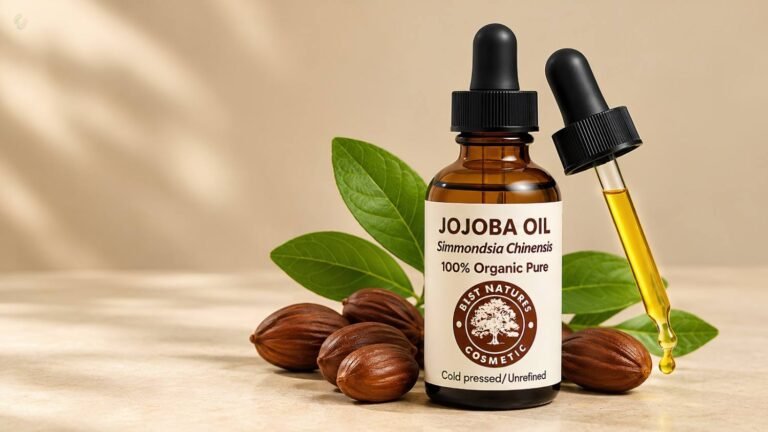
Choosing the right bottle matters, but it does not need to be complicated. Look for 100 percent pure jojoba oil, cold-pressed, with no added fragrance, no mineral oil, and no silicones listed. The oil should be a pale golden colour, almost clear, with a very light, nutty scent or almost no scent at all. If it smells strongly perfumed or looks very dark, it may be blended or old. Store it in a cool, dark place with the cap closed, and replace it if it starts to smell off or feels sticky. A good bottle lasts a long time because you are using drops, not handfuls, so a small bottle is often better than a large one you will not finish before it ages.
Long term, the habit that keeps jojoba oil for curly hair working is the same habit that keeps any curly routine working: watch your hair when it is dry, not just when it is wet. Wet hair always looks smoother. Dry hair tells the truth. If your curls feel soft, springy, and defined when dry, your dose and order are right. If they feel coated or limp, use less next time. If the ends feel rough, add water first and then one more drop. Keep a simple note for a few weeks, your curl type, your dose, whether you used jojoba before or after leave-in, and how your hair felt the next day. You will quickly see your own pattern, and that pattern is more useful than any generic chart, because it is yours.
For many people, jojoba becomes the quiet staple in a curly routine, not the star product, but the one they reach for most often. It does not promise to change your curl pattern, it does not claim to repair damage overnight, and it does not need a complicated routine to work. It needs water first, drops not pumps, and the right order for your curl type and porosity. Get those three things right, and your curls will feel softer, look shinier, and hold their shape longer, without the weight that makes so many oils a disappointment for curly hair.
If you are building a full curly routine around this, start with the dose map on your next wash day, try the damp-hair order exactly as described, and give it three washes before you decide. One wash day is not enough to judge a sealing oil, because your hair needs time to adjust to a lighter seal and you need time to find your dose. By the third wash, you will know whether one to two drops is your fine-curl dose, whether two to four drops suits your medium curls, or whether three to six drops in sections is what your thick coils need. That is the real promise of jojoba oil for curly hair: not a transformation, but a small, repeatable habit that keeps your curls moisturised, smooth, and defined, wash after wash.