Jojoba Oil for Hair Growth: What the Evidence Shows & How to Use It
If you have searched for jojoba oil for hair growth, you have probably seen the same promise repeated in a dozen places: rub it in, watch your hair grow. It sounds simple, and it is also misleading. Jojoba does not wake up sleeping follicles, it does not reverse pattern hair loss, and it does not add centimetres to your hair overnight. What it does do — and what makes it worth a place in a hair routine — is quieter and more useful than that. It protects the length you already grow, it keeps the scalp calm enough for growth to continue undisturbed, and it carries stronger ingredients to the scalp without the irritation that often makes people quit them. That is the honest story of jojoba oil for hair growth, and once you understand it, you can use it properly instead of expecting it to do a job it was never built for.
I first noticed the difference not in a mirror but in a hairbrush. A friend who had been trying to grow out a blunt bob kept complaining that her hair never seemed to get past her shoulders, even though she had not had a major cut in a year. Her ends were not growing slowly; they were breaking. The top six inches looked healthy, the bottom two inches looked frayed, and every wash took a little more length away. That is the problem jojoba oil for hair growth is actually good at solving. Hair grows from the root at roughly a centimetre a month whether you oil it or not. Whether you keep that centimetre depends on what happens to the shaft after it leaves the scalp. Jojoba oil for hair growth helps you keep it.
First, Jojoba Is Not Really an Oil at All
Almost every conversation about jojoba oil for hair growth starts with the wrong category. Jojoba is not a true oil. It is a liquid wax ester, pressed from the seeds of the jojoba shrub, and its chemistry is closer to the sebum your own scalp produces than to olive oil, coconut oil, or any kitchen oil you might reach for. That single fact explains most of its behaviour on hair.
Sebum is the waxy, slightly oily substance your scalp makes to coat the hair shaft, keep moisture in, and keep the skin barrier intact. When you wash too often, use a harsh shampoo, or live in dry air, you strip some of that coating away and the hair underneath becomes rougher, more porous, and more likely to snag and snap. Jojoba oil for hair growth slips into that gap because it resembles sebum so closely. It spreads thinly, it does not sit heavy in the way a thick triglyceride oil can, and it forms a light seal over the cuticle — the overlapping scales that cover each strand like roof tiles. When those scales lie flat, hair reflects light better, tangles less, and loses less water from inside the shaft.
This is also why jojoba oil for hair growth feels different from other oils in the hand. It is not sticky, it does not go rancid quickly, and a little goes a long way. People who say jojoba oil for hair growth made their hair greasy have usually used far too much of it, or they have used it on the scalp when their scalp was already producing plenty of sebum. Used in the right amount, in the right place, it disappears into the hair rather than coating it. For a full picture of what jojoba does beyond length, the general overview at jojoba oil benefits and uses covers its wider uses on skin and hair, while this article stays focused on one question: what it can and cannot do for growth.
The wax-not-oil distinction matters for another reason. True oils can penetrate the hair shaft to varying degrees. Jojoba oil for hair growth, as a wax ester, mostly stays on the surface. That sounds like a weakness until you realise that surface protection is exactly what long hair needs most. The inside of the shaft is built by your body, fed by blood, protein, iron, and the rest of your diet. No bottle can rebuild it from the outside. The outside, though — the cuticle, the ends, the places where a brush, a towel, a pillowcase, and a hair tie do their daily damage — that is where a surface seal earns its keep.
Why Jojoba Oil for Hair Growth Is So Often Misunderstood
The confusion around jojoba oil for hair growth comes from a simple mix-up between growing hair and keeping hair. Growing happens at the follicle, under the skin. Keeping happens along the shaft, above it. Most hair oils are sold as if they do the first job. Almost all of them, jojoba included, mainly do the second.
Think of it as retention math, because the numbers are kinder than the marketing. If your hair grows about a centimetre a month, that is twelve centimetres a year. If breakage trims two or three millimetres off the ends every month — through brushing wet hair, tight ponytails, heat styling, or simply rubbing against a cotton pillowcase — you lose a quarter to a third of that growth without ever picking up scissors. Over a year, that is three to four centimetres gone. You have not grown slowly. You have kept poorly.
Now imagine you cut that breakage in half. You do not grow faster. You simply arrive at December with an extra centimetre or two still attached. Nobody watching you would say your hair grew faster; they would say it looks longer, fuller at the ends, and healthier. That is the real result people report when they say jojoba oil for hair growth worked for them. Their follicles did not change gear. Their ends stopped disappearing.
This distinction protects you in two ways. First, it stops you from wasting months waiting for jojoba oil for hair growth to fix a problem it cannot fix — shedding from a deficiency, a hormonal shift, a scalp condition, or pattern hair loss all need a different answer, and often a clinician. Second, it lets you judge jojoba oil for hair growth fairly. If you measure success by fewer broken hairs in the shower drain, less frizz at the ends, and a ponytail that feels thicker at the bottom after three months, jojoba can pass that test. If you measure it by new hairs along a receding hairline, it will fail, and it should, because that was never its job.
The Evidence, Stated Plainly: Jojoba Oil for Hair Growth Has No Growth Trial Behind It
There is no human clinical trial showing that jojoba oil for hair growth stimulates new hair. That sentence belongs near the top of any honest article on the subject, and it belongs here before any routine or recipe. What exists instead is a mix of chemistry, animal work, and a long history of cosmetic use — useful, but not the same as proof.
The study most often quoted in this corner of the internet is a 2014 mouse study on hair growth. Read carefully, it says almost the opposite of what sellers claim. In that study, jojoba oil for hair growth was the control vehicle — the neutral base used to carry other ingredients — and it was outperformed by both minoxidil and peppermint oil. The mice treated with jojoba oil for hair growth alone did not show the growth response seen in the active groups. Jojoba oil for hair growth was there to be the quiet background, not the star, and it behaved like one.
That finding is not an insult to jojoba oil for hair growth. A good control vehicle is supposed to be gentle, stable, and non-irritating, and jojoba is all three. But it does mean you cannot point to that study as evidence that jojoba oil for hair growth works as a stimulant. Anyone who does is either misreading it or hoping you will not check. The honest reading is that jojoba oil for hair growth is a carrier and a conditioner that happened to be useful enough for researchers to trust it as a base — and that is a genuine strength, just not a growth claim.
Beyond that study, the evidence for jojoba oil for hair growth is indirect. We know jojoba oil for hair growth’s wax esters resemble sebum, we know sealing the cuticle reduces breakage, we know a calm scalp sheds less from irritation, and we know from cosmetic science that reducing friction and moisture loss keeps hair looking longer. None of that is a trial, and none of it should be dressed up as one. What it adds up to is a reasonable, low-risk way to protect length while you address the real drivers of growth — health, scalp condition, and, where needed, proven treatments — separately.
That is also why the flaking figures you sometimes see attached to jojoba should be treated with care. A number like a large percentage of participants improving in a single small or poorly described study tells you almost nothing without knowing who was studied, how flaking was measured, and whether the result has been repeated. This article leaves such figures out rather than repeating a number that cannot be verified. If a claim needs a percentage to sound convincing, it probably is not convincing enough on its own.
How Jojoba Protects Length: The Retention Story in Detail
To use jojoba oil for hair growth properly, it helps to picture what happens to a single strand between washes. A new hair emerges coated in sebum, smooth and flexible. Within days, shampooing, combing, sun, wind, and friction start to lift the cuticle scales at the edges. Once lifted, those scales catch on each other and on fabric, and the strand becomes more likely to tangle. Tangles lead to pulling, pulling leads to snapping, and snapping usually happens a few centimetres from the end, where the hair is oldest and weakest.
Jojoba oil for hair growth interrupts that chain at the earliest step. A thin layer over the cuticle smooths the surface, so strands slide past each other instead of catching. Less catching means less pulling when you brush, less frizz when the air is dry, and less moisture escaping from inside the shaft between washes. The effect is small on any single day and meaningful over months, which is why people who stick with it for a full season notice the change while people who try it twice and stop do not.
Split ends are the clearest example. A split end cannot be healed by any oil, jojoba included; once the shaft has split, only a trim removes it. What jojoba oil for hair growth can do is slow the formation of new splits by keeping the ends supple rather than dry and brittle. If you trim a centimetre every three months and jojoba oil for hair growth helps you arrive at that trim with fewer new splits, you keep more of the growth in between. That is retention in practice, and it is the only version of jojoba oil for hair growth that survives contact with the evidence.
There is a second, quieter benefit on the scalp itself. A dry, tight, flaky scalp makes people scratch, and scratching damages both skin and the hair emerging from it. Jojoba oil for hair growth’s sebum-like feel can ease that dryness without the heavy, pore-clogging sensation some thicker oils leave behind. It does not treat dandruff, eczema, or psoriasis, and if flaking is persistent, painful, or spreading, that needs proper assessment rather than more oil. But for ordinary dryness — the kind that comes with winter air, frequent washing, or a shampoo that is slightly too strong — a light scalp application can make the scalp feel comfortable again, and a comfortable scalp is a scalp you leave alone, which is half the battle.
Jojoba as a Carrier: The Role No Competitor Talks About Enough
Here is the part of the jojoba oil for hair growth story that most articles skip, and it may be the most practical reason to keep a bottle in your cupboard. Jojoba oil for hair growth is an excellent carrier oil. That means it can carry stronger, more active ingredients to the scalp — rosemary oil, peppermint oil, and even prescription topicals — diluting them enough to use safely while helping them spread evenly.
Rosemary oil is the clearest example. It has attracted real interest for hair, and many people want to try it, but undiluted essential oil on the scalp is a fast route to irritation, itching, and giving up after a week. Mixed into jojoba oil for hair growth, rosemary becomes usable: the jojoba spreads it thinly, buffers the intensity, and stays on the scalp long enough for a massage without evaporating in minutes. The combination of argan oil and rosemary oil for hair growth is often discussed in the same breath, and jojoba plays a similar supporting role there — a calm base that lets the active ingredient do its work without the scalp protesting.
The same logic applies to peppermint oil, which performed well in that 2014 mouse study mentioned earlier. Peppermint brings a cooling, tingling sensation that many people enjoy, but at full strength it is far too strong for the scalp. In jojoba oil for hair growth, a few drops become a pleasant, spreadable treatment rather than a sting. If you want to read more about peppermint on its own, peppermint oil for hair growth covers it in detail, and the carrier principle is the same whichever active oil you pair with jojoba.
Prescription topicals benefit from the same thinking, with one important boundary: never mix jojoba into a prescribed product unless the prescriber or pharmacist says it is fine, and never use jojoba as a reason to change a prescribed dose or schedule. The carrier idea is about comfort and spreadability for cosmetic oils you choose yourself, not about altering medicine. Used within that boundary, a light jojoba oil for hair growth base can make the difference between a routine you tolerate and a routine you abandon because your scalp feels raw.
Think of jojoba oil for hair growth, then, not as the engine of growth but as the road the engine travels on. A good road does not make a car faster by itself, but a bad road will slow any car down and shake it apart. Jojoba oil for hair growth keeps the scalp road smooth, and that is a job worth doing well.
How Much to Use: A Dose Map by Hair Type
The most common mistake with jojoba oil for hair growth is using too much. More oil does not mean more protection; it means limp hair, a greasy scalp, and a wash that strips away the very coating you just applied. The right dose is small, and it depends on your hair.
For fine hair, one to two drops is enough for the lengths and ends. Warm the drops between your palms until they almost disappear, then smooth them over the bottom third of your hair, where breakage happens most. Fine hair has less surface to cover and goes flat quickly, so if you can see oil on your hands after you have applied it, you have used too much. Start with one drop. You can always add a second tomorrow.
For medium hair, two to four drops will usually cover the lengths without weighing them down. Work through the ends first, then bring whatever is left on your palms lightly up the mid-lengths. The roots rarely need any oil at all unless your scalp is dry, and even then a separate, smaller amount massaged into the scalp is better than dragging length oil upward.
For thick, coarse, or curly hair, three to six drops is a reasonable range, and curly hair in particular often welcomes the upper end of that range because the bends in each strand make it harder for natural sebum to travel from root to tip. The ends of curly hair are almost always drier than the roots, and they are the first place breakage shows. Apply to damp hair after washing for the best seal, and add a single drop to dry ends between washes if they start to feel rough.
For the scalp, the dose is separate from the dose for the lengths. A teaspoon — roughly five millilitres — is plenty for a full scalp massage, and many people need less. Part the hair in sections, apply a few drops to the fingertips rather than pouring directly, and massage gently for two or three minutes. The point is contact and circulation from the massage itself, not flooding the scalp. If your hair looks oily at the roots the next morning, halve the amount next time before you blame the oil.
Frequency matters as much as dose. Two to three times a week is the sweet spot for most people using jojoba oil for hair growth as a retention routine. Daily use is fine on the very ends if they are dry, but daily scalp oiling often leads to build-up, especially if you are not washing thoroughly between applications. Consistency over weeks beats intensity over days, and a routine you can keep for three months will tell you far more than a heavy application you abandon after one greasy morning.
The Routine: How to Use Jojoba Oil for Hair Growth Step by Step
A routine only works if it fits into a real week, so here is one that does. It takes ten minutes on wash days and two minutes between them, and it is built around protection rather than promise.
Start with a patch test, every time you open a new bottle or switch brands. Put a single drop on the inside of your wrist or behind your ear, leave it for twenty-four hours, and watch for redness, itching, or a rash. A jojoba allergy is rare, but it exists, and the scalp is a bad place to discover it. If you have a known nut or seed allergy, or sensitive skin that reacts to new products easily, the patch test is not optional. It is the whole point.
On wash day, use jojoba oil for hair growth as a pre-wash treatment for the lengths. Apply your dose to dry hair an hour before you shower, concentrating on the ends, and loosely braid or clip the hair up while you wait. The wax layer gives the cuticle a little armour against the swelling and friction of washing itself, which is when wet hair is at its weakest. Shampoo as usual, condition the lengths, and rinse with lukewarm rather than hot water.
After washing, while the hair is still damp, apply a smaller dose — half your usual amount — as a leave-in seal. Damp hair absorbs a thin layer more evenly than dry hair, and the seal locks in the water from the wash before it evaporates. This is the single most useful step in the whole routine for jojoba oil for hair growth, because it is the step that directly reduces the daily moisture loss that makes ends brittle.
Between washes, keep it simple. One drop smoothed over the ends in the morning is enough to tame frizz and reduce friction against clothing. At night, a loose braid or a silk or satin pillowcase does more for retention than any oil, and jojoba oil for hair growth plus a low-friction night routine is a genuinely effective combination. The oil protects the surface; the pillowcase stops the rubbing that wears it away.
Once or twice a week, if your scalp feels dry, add the scalp massage described above, ideally an hour before washing so any excess is rinsed away. Massage with the pads of your fingers, not your nails, and keep the pressure gentle. The massage itself brings blood to the scalp and helps you notice changes — tenderness, flaking, or a sore spot — earlier than you otherwise would. If you are pairing jojoba oil for hair growth with rosemary or peppermint as a carrier, this is the step where the blend belongs: a teaspoon of jojoba with two to three drops of essential oil, massaged in, left for at least an hour, and washed out. Never apply undiluted essential oil to the scalp, and stop any blend that causes burning, persistent redness, or increased shedding.
What to Expect, and When: A Realistic Timeline for Jojoba Oil for Hair Growth
Honest timelines are unfashionable because they do not sell bottles, but they are the only kind worth giving. If you start using jojoba oil for hair growth today, here is what the next three months actually look like.
In the first two weeks, expect softer ends and less frizz. That is the surface seal working, and it is immediate. Your hair will feel smoother when you run your fingers through it, and brushing will meet less resistance. This is cosmetic, not growth, but it is real and it is the reason most people keep going.
By four to six weeks, you may notice less breakage: fewer short hairs in the brush, fewer snapped ends on your shoulders, a ponytail that feels a little more even at the bottom. This is harder to measure than softness, so do not rely on memory. Take a photo of your ends in the same light once a month, and compare the photos rather than trusting the feeling that nothing is changing.
By eight to twelve weeks, the length-retention difference becomes visible if it is going to. The hair you grew in those three months is still attached, and the ends look fuller than they did when you started. That is the milestone to judge jojoba oil for hair growth by. If your ends look the same after twelve weeks of consistent use, two to three times a week, at the right dose, then jojoba is not the missing piece for your hair, and something else — diet, a scalp condition, heat damage, or a medical cause of shedding — deserves attention instead.
What you should not expect at any point is new hair where hair has stopped growing, a thicker hairline, or a sudden increase in growth speed. Hair grows at the rate your body sets, and no surface oil changes that rate. Anyone promising faster growth from jojoba oil for hair growth is selling a feeling, not a result. The right expectation is not dramatic; it is durable. Longer-looking hair because less of it broke, a calmer scalp because it was not stripped and scratched, and a routine you can sustain without irritation.
Jojoba Compared With the Other Growth Oils, in Plain Prose
It helps to place jojoba oil for hair growth beside the other oils people reach for when they want longer hair, because each one does a different job and choosing the wrong one for your problem wastes months.
Argan oil for hair growth is the closest cousin to jojoba in feel: light, fast-absorbing, and good at smoothing frizz and adding shine. Argan is a true oil, rich in fatty acids and vitamin E, and it penetrates the shaft a little more than jojoba does. If your hair is dry and dull and you want softness and shine, argan is often the better first choice. If your scalp is the issue, or you want a carrier for essential oils, jojoba oil for hair growth’s sebum-like wax has the edge. Many people use both — argan on the lengths for softness, jojoba on the scalp as a base — and that combination is perfectly sensible. For the practical steps of using argan in a growth routine, how to use argan oil for hair growth walks through the method in detail.
Castor oil for hair growth sits at the opposite end of the spectrum: thick, sticky, and heavy, with a long folk history as a growth oil. Castor is much harder to wash out, it can weigh fine hair down badly, and its reputation for growth rests on tradition rather than trials. Where it earns its place is as an intensive treatment for very dry, coarse hair that needs a heavy seal, used sparingly and washed out thoroughly. Jojoba oil for hair growth is the everyday oil; castor is the occasional heavy-duty one. If you have fine hair and you have tried castor and hated the residue, jojoba oil for hair growth will feel like a relief.
Amla oil for hair growth comes from a different tradition again, the Ayurvedic use of Indian gooseberry, and it is usually sold as an oil infused with amla fruit. Its fans value it for scalp health and for the deep conditioning feel it gives. It is heavier and more fragrant than jojoba, and it stains light fabrics more easily. If you enjoy a traditional oiling ritual and your scalp tolerates richer oils, amla is a reasonable choice. If you want something light, odourless, and unlikely to stain your pillowcase, jojoba oil for hair growth is the easier daily companion.
The pattern is simple. No one of these oils grows hair. Each protects it in a slightly different way, and the best choice depends on your hair type, your scalp, and whether you can stand the texture long enough to use it consistently. Jojoba oil for hair growth wins on lightness, scalp compatibility, and its carrier role. It loses if what you want is deep penetration or a heavy, conditioning mask. Knowing that trade-off before you buy is better than discovering it after three weeks of greasy roots.
Who Jojoba Helps Most — and Who Should Skip It
Jojoba oil for hair growth helps most the person whose hair grows at a normal rate but never seems to get longer. If your hairdresser trims the same split ends every visit, if your ponytail thins toward the bottom, if your hair reaches shoulder length and then seems stuck there for a year, retention is likely your problem and jojoba is a reasonable, low-risk tool for it. It also helps the person with a dry, tight scalp who wants a gentle moisturiser that will not clog pores or trigger breakouts along the hairline, and the person who wants to try rosemary or peppermint oil but has a scalp that flares at the first sign of a strong essential oil.
Curly and coily hair often benefits more than straight hair, because the bends in the strand make it harder for sebum to travel down, leaving the ends chronically drier. Thick hair benefits more than fine hair for the same reason — more surface to protect, more length to lose to breakage. People who heat-style regularly, swim, or live in dry climates will also notice the protective effect sooner, because their cuticles face more daily wear.
Jojoba oil for hair growth helps least the person whose shedding has a medical cause. If you are losing hair in clumps, seeing widening partings, noticing bald patches, or shedding far more than usual for more than a few weeks, oil is not the answer and delaying proper advice costs you time you cannot get back. Pattern hair loss, thyroid problems, iron deficiency, and scalp conditions all need assessment, not a bottle. Jojoba oil for hair growth will not make those worse — it is gentle — but it will not make them better either, and pretending otherwise is unkind.
It also deserves a note for people with very oily scalps. If your scalp already produces abundant sebum and your roots go flat by midday, adding jojoba to the scalp will make that worse, not better. Use it on the ends only, keep it away from the roots, and wash thoroughly. The same applies if you are prone to scalp acne: keep the oil on the lengths, patch test first, and stop if breakouts appear along the hairline.
Buying and Storing Jojoba: What to Look For
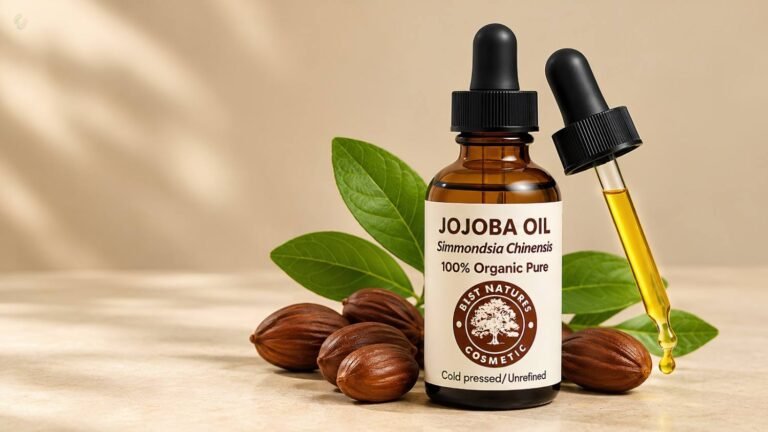
Not all jojoba is equal, and the label tells you most of what you need to know. Look for cold-pressed, unrefined jojoba oil — sometimes sold as golden jojoba — in a dark glass bottle. Golden means it has been minimally processed and retains its natural colour and faint nutty scent. Clear or refined jojoba has been processed further; it is still jojoba, but it has lost some of the compounds that make the unrefined version appealing, and it is often chosen for cosmetic formulas where colour matters rather than for direct hair use.
The ingredient list should say one thing: Simmondsia chinensis seed oil. If the bottle lists a blend, mineral oil, fragrance, or a long list of additives, you are not buying jojoba, you are buying a product that contains some jojoba. That matters because the sebum-mimicking behaviour depends on the wax esters being present in meaningful amounts, not as a token ingredient at the bottom of a list.
Store it somewhere cool and dark, with the cap on, and it will last a long time — one of jojoba’s practical advantages is that its wax structure resists going rancid far better than most true oils. If it smells sharp, sour, or noticeably different from when you opened it, replace it. A small bottle lasts months at one to six drops per use, so buy small and fresh rather than large and stale.
Price is a poor guide to quality here. Expensive does not mean purer, and a mid-priced cold-pressed bottle from a reputable supplier is usually all you need. Be wary of any product that promises growth on the label — that promise is the clearest sign the seller has not read the evidence, and it tells you more about their marketing than about the oil inside.
Mistakes That Undo the Benefit of Jojoba Oil for Hair Growth
The first mistake is the dose, already covered: too much oil, applied to the roots of fine hair, then blamed on the oil when the hair goes flat. Start small. You can add more; you cannot easily take it away without washing.
The second mistake is expecting jojoba oil for hair growth to replace a trim. Split ends do not heal, and oiling over them for months while avoiding the scissors leaves you with longer hair that looks thinner at the bottom. A small trim every ten to twelve weeks, removing only the damaged tips, keeps the ends blunt and full, and jojoba’s job is to make sure you need to trim less each time, not to make trimming unnecessary.
The third mistake is using jojoba oil for hair growth as a heat protectant. It is not one. A thin wax layer offers a little protection against friction, but it does not protect against the temperatures of a straightener or curling iron. If you heat-style, use a proper heat protectant first, let it dry, and use jojoba after styling on the ends if you like, not before the iron touches the hair.
The fourth mistake is leaving a heavy scalp application in for days without washing. Jojoba is gentle, but any oil left on the scalp builds up, traps sweat and dead skin, and can make itching and flaking worse rather than better. An hour before washing, or overnight at most with a thorough wash in the morning, is the limit. If your scalp feels coated or itchy after oiling, you have left it too long or used too much.
The fifth mistake is mixing too many actives at once. Jojoba oil for hair growth plus rosemary is a sensible pair. Jojoba plus rosemary plus peppermint plus three other essential oils is a chemistry experiment on your scalp. Introduce one active at a time, patch test each blend, and give it a month before you judge it. Your scalp will tell you quickly if it is unhappy; the skill is listening the first time.
A Simple Three-Month Plan for Jojoba Oil for Hair Growth
If you want a plan rather than a pile of tips, here is one that fits on a single page and respects the evidence for jojoba oil for hair growth. Month one is about learning your dose. Use the dose map above, apply to damp ends after every wash, add a weekly scalp massage if your scalp is dry, and take a photo of your ends on day one. Do not change anything else in your routine that month — no new shampoo, no new treatment — so you can tell what jojoba oil for hair growth itself is doing.
Month two is about consistency. Keep the same dose, two to three times a week, and add the carrier step if you want to try rosemary: a teaspoon of jojoba with two to three drops of rosemary oil, massaged into the scalp an hour before washing, once a week to start. Take your second photo at the end of the month and compare it with day one, looking at the ends rather than the roots. Are there fewer flyaways? Does the ponytail feel more even? That is the signal to watch for.
Month three is the decision point. By twelve weeks you should see the retention difference if it is there: ends that look fuller, less breakage in the brush, hair that holds length between trims. If you see it, keep the routine — it is working, quietly, in the way jojoba oil for hair growth works. If you do not, stop and reassess. Check your diet, your iron and vitamin D if shedding is a concern, your heat styling, and whether a scalp condition needs attention. Jojoba oil for hair growth has done what it can; the next step is elsewhere.
Through all three months, keep the habits that matter more than any oil. Do not brush wet hair aggressively, use a wide-tooth comb on damp hair, keep hair ties loose, protect hair from harsh sun and chlorinated water where you can, and eat enough protein. No oil compensates for a diet that does not give the follicle the building blocks it needs, and no routine survives a brush that rips through tangles every morning.
The Bottom Line on Jojoba Oil for Hair Growth
Jojoba oil for hair growth is a story of a modest, honest helper being sold as a miracle. It is a liquid wax that mimics sebum, seals the cuticle, cuts breakage, calms a dry scalp, and carries stronger ingredients without irritating the skin. It does not stimulate follicles, it does not regrow hair, and the one animal study people quote used it as the control, not the cure. That is not a reason to dismiss it. It is a reason to use it correctly.
Used at the right dose for your hair type — one to two drops for fine hair, three to six for thick hair — two to three times a week, with a patch test first and twelve weeks of patience, jojoba helps you keep the length your body already grows. The growth is yours. Jojoba oil for hair growth just helps you hold on to it. And in a world of hair products that promise everything and deliver little, a helper that does one job well, without side effects and without hype, is worth keeping on the shelf.
If your hair grows but never seems to get longer, start with the ends, start small, and give it three months. Take the photo, count the broken hairs, and let the evidence in your own mirror — not a label, not a percentage, not a promise — decide whether jojoba oil for hair growth earns a permanent place in your routine.