Jojoba Oil for Skin: Acne, Wrinkles & How to Use It
Jojoba oil for skin is one of those ingredients that sounds too good to be true: an oil that helps oily skin, softens dry skin, calms breakouts and smooths fine lines, all from one golden bottle. I have lost count of the guides that promise all of that in the first paragraph and then never explain who it actually suits, or what the research really tested. This article does the opposite. It starts with the two things most guides bury — a simple skin-type map, so you can tell in about a minute whether jojoba is likely to suit you, and an honest look at the best acne study we have, which did not test raw oil at all.
That study, published in Germany in 2012, is the reason so many articles claim that jojoba oil for skin clears acne. The researchers did find fewer spots and fewer blackheads and whiteheads after six weeks. But the treatment was a clay mask containing jojoba oil, used two to three times a week — not neat jojoba oil dabbed on the face every night. Clay alone draws out oil and debris, so we cannot honestly credit the jojoba for the whole result. The mask result is still useful, and it is still the strongest acne evidence we have for jojoba, but it is a mask result, and you deserve to know that before you buy a bottle expecting the same outcome from the oil alone. Everything that follows is written with that same honesty: what jojoba oil for skin may help with, what it probably cannot do, and how to use it in a way that gives your skin a fair chance.
If you want the broader picture first — jojoba for hair as well as skin, its history, and how it compares with other carrier oils in general — our general guide to jojoba oil benefits and uses covers that ground. This article stays firmly on skin: acne, dryness, ageing, sensitivity, and the practical question of which bottle to buy and how much to use.
Jojoba Oil for Skin: What It Actually Is
Jojoba oil for skin starts with a small correction. It is not really an oil at all. It is a liquid wax, pressed from the seeds of the jojoba shrub, a tough desert plant native to the southwestern United States and northern Mexico. Chemically it is made mostly of long-chain wax esters, and those esters look a lot like the sebum your own skin produces. That resemblance is the whole story behind jojoba’s reputation, and it is worth understanding properly, because it explains both why jojoba oil for skin works so well for some people and why it disappoints others.
Sebum is the natural oil your sebaceous glands make to keep skin supple and protected. When your skin is dry, it often makes more sebum to compensate; when it is oily, it can keep overproducing because the surface feels stripped, especially after harsh cleansers. Jojoba oil for skin sits on the skin in a way that resembles sebum closely enough that the skin seems to register it as “enough oil already here”. That is the famous sebum-mimicry idea, and while it is usually stated as fact in marketing copy, it is more honest to call it a plausible mechanism supported by jojoba’s chemistry and by a lot of consistent user experience, rather than a proven feedback loop measured in a laboratory. Nobody has put a meter on your sebaceous glands and watched them slow down in real time. What we do know is that jojoba oil for skin spreads easily, absorbs without the heavy grease of many plant oils, and leaves a soft, satin finish rather than a shiny film, which is exactly what you would expect from something so close in structure to your own sebum.
That closeness also explains why jojoba oil for skin rarely feels like an intruder. Many plant oils sit on top of the skin and feel foreign; jojoba oil for skin blends in. It is naturally rich in vitamin E, which acts as an antioxidant, and it contains small amounts of other compounds that help protect the oil itself from going rancid quickly. A good bottle keeps well, often for a year or more if you store it away from heat and light, and it does not have the strong nutty smell of some oils. The colour tells you something important, and we will come back to that in the buying section, because the difference between golden unrefined jojoba and pale refined jojoba is one of the few buying decisions that genuinely matters for skin.
Before we go further, one more piece of context helps. Jojoba oil for skin is not a medicine, and it is not a substitute for one. If you have moderate or severe acne, eczema that keeps flaring, or a skin condition that is getting worse, a dermatologist will do more for you in one visit than any bottle on a shelf. What jojoba oil for skin can be, for many people, is a gentle, well-tolerated moisturising oil that supports the skin barrier, softens dryness, and — used the right way — fits into an acne-prone routine without adding to the problem. That is a smaller promise than the one on most labels, but it is one the evidence can actually carry.
The Clay-Mask Trial: The Best Acne Evidence, Honestly Framed
Let us look closely at that 2012 German study, because jojoba oil for skin deserves a fair hearing on acne, and a fair hearing means looking at what was actually tested. The researchers recruited 194 people with mild acne and split them into groups. One group used a facial mask made from clay with jojoba oil added; another used a clay mask without jojoba; a third group used no mask treatment. Everyone used the mask two to three times a week for six weeks, and the researchers counted lesions — spots, blackheads and whiteheads — before and after.
The results were genuinely encouraging. The group using the clay and jojoba mask saw their lesion count fall by roughly half, and they did better than the clay-only group, which suggests the jojoba was adding something beyond what the clay did alone. That is a real, useful finding, and it is why this study keeps being cited. It is also a finding with limits that matter. There were 194 participants, which is respectable for a cosmetic study, but the trial lasted only six weeks, the acne was mild, and the treatment was a mask, not a leave-on oil. A mask sits on the skin for ten or fifteen minutes and is then washed off; a facial oil stays on for hours. The two are not interchangeable, and nobody in the study was testing whether rubbing pure jojoba oil for skin onto a breakout every night would clear it.
So what can you honestly take from it? Three things. First, jojoba in a clay mask helped mild acne over six weeks, which is more than we can say for most oils, where the evidence is often nothing more than tradition. Second, the effect was moderate — a reduction, not a cure — and it needed regular use, two to three times a week, not a single application. Third, it tells us nothing direct about severe acne, about using jojoba oil for skin on its own, or about what happens after six weeks. If a guide tells you that jojoba oil clears acne and cites this study without mentioning the clay or the mask, it is overstating the case, however good its intentions.
There is a second, smaller thread of evidence worth mentioning, because it shows how jojoba might work rather than just whether it worked in one trial. Laboratory studies have found that jojoba oil has mild antimicrobial activity against some of the bacteria associated with acne, and its wax esters can help dissolve the waxy plugs that block pores. In plain language, jojoba is good at mixing with the skin’s own oils, which may help loosen congestion rather than adding to it. That is a mechanism, not a guarantee — a petri dish is not a face — but it fits with what the mask trial found, and it fits with why so many people with oily skin report that jojoba oil for skin feels balancing rather than clogging.
The practical upshot is simple. If you have mild acne and you want to try jojoba, the most evidence-backed way to do it is the way the study did it: as part of a clay mask, two to three times a week, alongside a gentle cleanser and a moisturiser that suits you, not as a miracle oil applied neat to every spot. You can also use a few drops of jojoba oil for skin as a light facial oil, and many people do exactly that with good results, but be honest with yourself about which of those two things you are doing. The mask has evidence; the neat oil has a plausible mechanism and a lot of happy users, which is encouraging but not the same thing.
The Skin-Type Map: Who Jojoba Suits, and Who Should Think Twice
Here is the map that most guides skip, and it is the fastest way to decide whether jojoba oil for skin belongs in your routine. Skin is not one thing, and an oil that is perfect for one type can be a waste of money — or a mild nuisance — for another. Read the section that sounds like you, and skip the rest until you need it.
If your skin is oily or acne-prone, jojoba is usually your best-case scenario among oils. Because jojoba oil for skin resembles sebum, it spreads thinly, absorbs quickly, and does not leave the heavy, shiny layer that makes oily skin look oilier. Many people with oily skin find that a few drops of jojoba oil for skin after washing actually leaves their face looking less greasy by midday than using no oil at all, probably because the skin is not left feeling stripped and scrambling to replace lost moisture. It is also non-comedogenic in the usual sense — it is not known for clogging pores — which matters more for this skin type than for any other. That said, oily does not mean invincible. If you are in the middle of a bad breakout, adding any new product, even a gentle one, can muddy the picture, so introduce jojoba when your skin is relatively calm, use the patch test described later, and give it two weeks before you judge it. And keep your expectations in line with the trial: jojoba may help reduce congestion and support your routine, but it is not a replacement for a proper acne treatment if your acne needs one.
If your skin is combination and you are considering jojoba oil for skin — oily across the forehead and nose, normal or dry on the cheeks — jojoba is arguably at its most useful. Combination skin is hard to moisturise because one product rarely suits both zones, and jojoba’s light, balancing feel is one of the few things that works across the whole face without making the T-zone shine or leaving the cheeks tight. A common approach is two to three drops pressed over the whole face on damp skin, with an extra drop on the drier cheeks if they need it. Used this way, jojoba oil for skin acts less like a heavy treatment and more like a flexible base layer that evens things out, and you can layer a richer cream on the dry areas on cold days without changing the oil itself.
If your skin is dry, jojoba can help, but it has a limit you should know about before you expect too much. Jojoba oil for skin is a good emollient — it softens and smooths the surface and helps reduce water loss — but it is a light oil, and very dry skin often needs something heavier and more occlusive, something that sits on the surface longer and seals moisture in. Think of it this way: jojoba is a light jacket, and very dry skin in winter sometimes needs a coat. You can still use jojoba oil for skin if your skin is dry, and many people with dry skin love it, but use it as a first layer on damp skin and follow it with a richer cream or a heavier oil, rather than expecting jojoba alone to carry a whole dry-skin routine. If your skin feels tight again within an hour of applying jojoba, that is your skin telling you it needs more, not that jojoba has failed — it just was not enough on its own.
If your skin is sensitive, jojoba is one of the safer oils to try, and that is not a small thing. It is generally well tolerated, it has no strong fragrance in its pure form, and allergic reactions are rare, though they are real and we will cover the patch test properly below. Sensitive skin often reacts to the fragrance, preservatives and active ingredients in creams rather than to a simple oil, so a single-ingredient product like pure jojoba can be a relief. Start slowly, one product change at a time, so you know what caused a reaction if one happens, and choose an unrefined golden jojoba with nothing else added — no essential oils, no fragrance, no “blend” on the label. The fewer ingredients, the easier it is to trust the result.
If your skin is mature and your main concern is fine lines, jojoba can play a supporting role, but keep the promise in proportion. Its vitamin E and antioxidant content may help protect skin from the kind of everyday oxidative stress that contributes to ageing over time, and well-moisturised skin always looks smoother than dry skin, so fine lines look softer after you apply it. That is real, and it is worth having. What jojoba oil for skin cannot do is remove wrinkles, rebuild collagen, or turn back the clock on sun damage. No oil can. If a product promises that, it is selling you a story, not a result. Use jojoba oil for skin to keep mature skin soft, supple and comfortable, and let proven ingredients — sunscreen above all, and retinoids if your skin tolerates them — do the heavy lifting on ageing itself.
Jojoba Oil for Skin and Acne: What It May Help, and What It Will Not Do
Acne is where the claims about jojoba oil for skin get loudest, so it is worth slowing down and separating the three different things people mean when they say “jojoba helps acne”. The first is the mask evidence we have already covered: a clay mask with jojoba, used regularly, reduced mild acne lesions over six weeks. The second is the mechanism: jojoba mixes well with sebum, may help loosen blocked pores, and shows mild antimicrobial activity in the lab. The third is everyday experience: thousands of people with oily, spot-prone skin say jojoba feels light, does not break them out, and leaves their skin calmer than heavier oils do. None of those three is a promise that jojoba will clear your acne, but together they make a reasonable case for trying it — carefully — if your acne is mild and you want a gentle oil in your routine.
There is a useful comparison here that keeps the expectations honest. Tea tree oil is the oil most people reach for when they want something actively antibacterial on a spot, and it has its own evidence base for acne, but it is strong, it must be diluted, and it can irritate skin if you overdo it. Jojoba is the opposite kind of product: gentle, supportive, unlikely to irritate, but also unlikely to act like a spot treatment on its own. If you want to read how the stronger option is used properly, our guide to tea tree oil for acne explains dilution and patch testing in detail, and it is worth reading before you put any essential oil near a breakout. Jojoba oil for skin and tea tree can work together — a drop of diluted tea tree in a little jojoba as a carrier is a classic combination — but do not confuse the two roles. Jojoba oil for skin is the gentle carrier and skin conditioner; tea tree is the active ingredient doing the heavier work.
For acne-prone skin, the way you use jojoba oil for skin matters as much as whether you use it. The most sensible routine is a gentle, non-stripping cleanser, then two to three drops of jojoba pressed onto damp skin, morning and night, with sunscreen in the morning and any acne treatment your dermatologist or doctor has recommended kept exactly as prescribed. Do not stop a prescribed treatment to try an oil, and do not layer five new products at once and then blame the oil when something goes wrong. If you prefer the mask route for jojoba oil for skin, and it is the route with the actual trial behind it, mix a teaspoon of plain clay — bentonite or kaolin, whichever your skin tolerates — with enough water to make a paste, add three or four drops of jojoba, apply a thin layer, leave it for ten minutes, and rinse with lukewarm water. Two to three times a week is the trial frequency, and it is a sensible ceiling; more often than that and you risk drying your skin out, which is the opposite of what you want when you are trying to calm it down.
One more honest note for acne-prone readers. Some people find that any oil, even jojoba oil for skin, feels wrong on their skin during an active breakout, and that is a valid result, not a failure. Skin is individual, and the fact that jojoba oil for skin is non-comedogenic in general does not guarantee it will suit your particular skin on a particular week. If you try it for two weeks and your breakouts get worse, stop, let your skin settle, and try again later or not at all. A good skincare ingredient is one that works for you, not one that works for everyone else on the internet.
Wrinkles and Ageing: The Antioxidant Story, Without the Miracle
Now to wrinkles, where the marketing gets even louder. You will see jojoba oil for skin described as anti-ageing, wrinkle-reducing, even wrinkle-removing, and none of those words means the same thing, so let us be precise. What jojoba oil for skin actually offers for ageing skin is an antioxidant mechanism plus vitamin E. Vitamin E is an antioxidant that helps neutralise the free radicals generated by sunlight, pollution and everyday metabolism — the same kind of oxidative stress that, over years, contributes to the breakdown of collagen and the formation of fine lines. Jojoba oil for skin contains vitamin E naturally, and applying it to the skin puts that antioxidant where it can do some good. That is a genuine, plausible benefit, and it is the reason jojoba appears in so many anti-ageing formulations.
What jojoba does not offer is proof that it removes wrinkles. There is no good trial showing that rubbing jojoba oil for skin onto wrinkles makes them disappear, and there is no reason to expect one. Wrinkles form because collagen and elastin break down with age and sun exposure, because skin loses volume and elasticity, and because years of facial movement etch lines into the surface. An oil can moisturise the surface, which makes fine lines look softer immediately — dry skin shows every line, hydrated skin shows fewer — and it can supply antioxidants that may help slow further damage, but it cannot rebuild collagen or fill a wrinkle from the outside. Anyone who tells you otherwise is either mistaken or selling something.
That does not make jojoba oil for skin useless for mature skin. Far from it. Well-moisturised skin looks healthier, feels more comfortable, and shows fine lines less starkly, and jojoba is very good at that softening, smoothing job. It also layers well under sunscreen and makeup, which matters, because the two most useful anti-ageing habits you can have are wearing sunscreen every day and not stripping your skin barrier with harsh products. Think of jojoba oil for skin as a supporting player in an anti-ageing routine: it keeps the skin supple and comfortable, it supplies vitamin E, and it makes everything else you use sit better. The leading roles belong to sunscreen, and, if your skin tolerates them, to retinoids and other ingredients with direct evidence for collagen and cell turnover. Used that way, honestly, jojoba earns its place without needing to pretend to be something it is not.
If you are comparing oils for ageing skin, it helps to know how jojoba sits beside the others. Argan oil, for example, is richer and often feels more nourishing on mature, dry skin, and our guide to argan oil for skin explains where it shines and where it can feel heavy. Rosehip oil is the one most often talked about for scars and uneven tone, and our article on rosehip oil for acne scars covers that angle in detail. Jojoba oil for skin is lighter than both, which is why it suits oily and combination skin better, and why mature skin that is also oily often prefers jojoba to the richer options. There is no single best oil for ageing; there is only the oil that suits your skin type, your climate, and the rest of your routine.
Dry Skin, Eczema and Psoriasis: Soothing, Not Treating
Dry skin is the simplest case for jojoba oil for skin, and the easiest to explain. Dry skin is skin that has lost water, and usually lost some of the lipids that hold water in. Jojoba, as an emollient, softens the surface, smooths the rough, flaky feeling that dry skin gets, and forms a light barrier that slows water loss. Applied to damp skin, jojoba oil for skin — and the damp part matters, because the oil seals in the water that is already there rather than adding water itself — it leaves skin feeling comfortable for hours. Many people with dry patches on their cheeks, hands, elbows or shins find that jojoba is enough for mild dryness, especially in warm weather, and that it absorbs without the sticky feeling some heavier oils leave behind.
For very dry skin, though, the honest advice is the same as in the skin-type map: jojoba alone may not be enough. In winter, in a dry climate, or after a hot shower that has stripped the skin, a light oil can feel like it disappears too quickly. The fix is not to use more jojoba — drowning dry skin in a light oil does not turn it into a heavy one — but to layer. A few drops of jojoba oil for skin on damp skin, followed by a richer cream or a heavier oil, gives you the softening of jojoba plus the staying power of the cream. If you want a richer plant oil to compare, our guide to coconut oil for skin explains why coconut feels so much heavier and where it suits dry skin better, and also why it is a poor choice for acne-prone skin. The two oils are almost opposites in feel, and knowing that saves you from buying the wrong one for your skin type.
Eczema and psoriasis need even more care with language, because these are medical conditions and people living with them deserve honesty, not hype. The evidence for jojoba here is limited to its anti-inflammatory mechanism and a handful of small studies, not proof of treatment. In the laboratory, jojoba has shown mild anti-inflammatory activity, which is plausible given its composition, and small studies and case reports have suggested it may help soothe dry, irritated skin. That is enough to say that jojoba oil for skin may help soothe the dryness and discomfort that come with eczema or psoriasis, and many people with those conditions do use it as a gentle moisturiser between flare-ups. It is not enough to say that jojoba treats eczema, cures psoriasis, or replaces a prescribed cream, and this article will not say that. If you have eczema or psoriasis, keep using whatever your doctor has prescribed, and treat jojoba as a possible supporting moisturiser, not as a treatment. Patch test first, as always, and stop if the area gets redder, itchier or more irritated, because even a gentle oil can be the wrong thing on broken or inflamed skin.
The same soothing logic applies to skin that is irritated for simpler reasons — and here jojoba oil for skin can help for simpler reasons — after shaving, after a long day in wind or sun, or after overdoing an active ingredient like a strong exfoliant. A few drops of plain jojoba can calm the tight, stingy feeling and help the barrier recover, precisely because it is simple and close to the skin’s own lipids. That is one of the most underrated uses of jojoba oil for skin, and one of the most honest: it is not fixing the underlying problem, but it is giving the skin a comfortable, low-risk layer while it recovers.
How to Use Jojoba Oil for Skin: The Practical Routine
Knowing whether jojoba suits you is only half the job; the other half is using it in a way that actually works. The good news is that jojoba oil for skin is forgiving, and the routine is simple. The bad news is that most people either use too much of it or use it on dry skin and then wonder why it feels greasy or does nothing. Here is the routine that works for most people, most of the time.
Start with a patch test, every time you open a new bottle. Put a single drop on the inside of your forearm or behind your ear, leave it for 24 hours, and watch for redness, itching, swelling or a rash. Jojoba allergy is rare, but it is real, and a patch test costs you a day and saves you a face full of irritation. If the patch test is clear, start with two to three drops on damp skin, not five or ten. Warm the drops between your palms, press them gently onto your face and neck, and let the skin absorb them for a minute before you put anything else on. Two to three drops is genuinely enough for a whole face; jojoba spreads a long way, and using more mostly leaves a shine you do not want. If your skin drinks it up in minutes and still feels tight, you can add another drop, but add it because your skin asked for it, not because the bottle makes it easy to pour.
Damp skin is the detail that changes everything, and it is the one most people miss. Oil does not hydrate skin on its own; jojoba oil for skin seals in the water that is already there. So apply jojoba oil for skin straight after washing, while your face is still slightly damp, or after a hydrating toner or a splash of water. On dry skin, the same few drops sit on the surface, feel greasy, and do less good. On damp skin, they glide on, absorb quickly, and lock the moisture underneath. The same rule applies on the body: apply after a shower, while the skin is still damp, and you will need less oil and get a better result.
Morning and night play slightly different roles. In the morning, jojoba oil for skin works as a light moisturiser under sunscreen, and it layers well under makeup — a thin layer, allowed to absorb for a few minutes, gives foundation something smooth to sit on without making it slide. In the evening, jojoba oil for skin works as a final step after any serums or treatments, sealing them in and softening the skin overnight. If you use a retinoid or an exfoliating acid at night, jojoba can be a useful buffer, applied after the active product to reduce dryness and irritation, but do not mix the active into the oil unless you know what you are doing, because dilution changes how the active behaves. And one warning that belongs here, not buried at the end: jojoba oil has a natural sun protection factor of around 4, which sounds like a benefit until you remember that dermatologists recommend SPF 30 at minimum. SPF 4 is not sun protection in any meaningful sense, and jojoba oil for skin should never be used as a substitute for sunscreen. Use your sunscreen every morning, every day, with jojoba underneath it if you like, and never instead of it.
Beyond the face, jojoba is useful in a handful of everyday ways. A few drops of jojoba oil for skin make a gentle makeup remover for light makeup — massage it over the skin, wipe it away with a warm, damp cloth, and follow with your usual cleanser, because an oil cleanser that is not washed off properly can leave residue. It works as a cuticle oil, a lip softener, a beard oil for the skin underneath the beard, and a way to calm dry, flyaway ends of hair, though hair is a separate topic and our general jojoba guide covers it better. Jojoba oil for skin also works as a carrier oil, which simply means a gentle base oil you can mix a drop or two of essential oil into before putting the essential oil on your skin. Essential oils should never go on skin undiluted, and jojoba is one of the best carriers for that job because it is so well tolerated and so close to sebum.
Jojoba Oil for Skin: The Buying Test — Golden Unrefined vs Refined
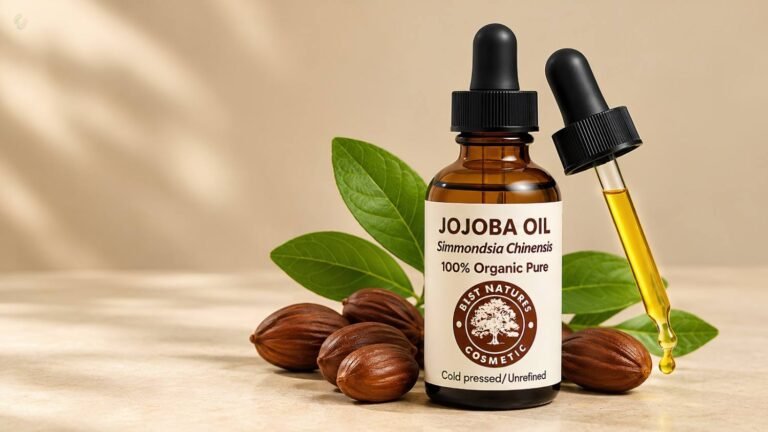
Walk into a shop or search online for jojoba oil for skin and you will find bottles at wildly different prices, in different colours, with different claims on the label, and it is not obvious which one is worth your money. Here is the test that actually matters, and it takes about ten seconds once you know what to look for. The first thing to check is the colour. Good, unrefined jojoba oil for skin is golden — a clear, warm, golden-yellow liquid. Refined jojoba is pale, almost colourless, because refining strips out the colour, the smell, and, along with them, some of the compounds that make unrefined jojoba useful. Refined jojoba oil for skin is not harmful, and it has a longer shelf life and a more neutral feel, but for skin, the golden unrefined version is generally the better choice, because it is closer to the oil as the plant made it, with its natural vitamin E and other minor compounds intact. If the bottle in your hand is water-clear and the label says nothing about being cold-pressed or unrefined, you are probably looking at a refined oil, and you are paying for a lesser product.
The second thing to check is the ingredient list, and it should be very short. It should say one thing: Simmondsia chinensis seed oil, which is the botanical name for jojoba, and nothing else. No fragrance, no mineral oil, no “jojoba blend” that is mostly cheaper oil with a little jojoba added, no vitamin E oil listed as a separate ingredient to make the label sound richer. A blend is not automatically bad, but a blend is not pure jojoba, and you should not pay a pure-jojoba price for one. The label should also say cold-pressed, which means the oil was extracted without high heat, and ideally it should say organic if that matters to you, though organic certification is a farming standard, not a guarantee of quality on your skin. A dark glass bottle is a good sign, because light degrades oil over time, and a bottle that tells you the expiry date or the pressing date is a better sign still.
The third thing to understand is oleic acid, because this is the detail that separates a good jojoba from a poor one for acne-prone skin. Oleic acid is a fatty acid found in many plant oils, and in high amounts it is comedogenic — it can contribute to clogged pores. Jojoba oil for skin is naturally low in oleic acid, which is one of the reasons jojoba oil for skin is so well tolerated by oily and acne-prone skin, and why it feels so different from, say, olive oil, which is high in oleic acid and much more likely to feel heavy and clogging. But not all jojoba is equal, and cheaper, poorly processed or adulterated jojoba can have a different fatty-acid profile than good jojoba should. You cannot test oleic acid at home, so the practical version of this test is to buy from a brand that publishes its fatty-acid profile or at least its quality testing, and to be suspicious of a bottle that is far cheaper than every other pure, cold-pressed, unrefined jojoba on the shelf. If it is suspiciously cheap, it is often diluted, refined, or not what the label claims, and for acne-prone skin that difference matters.
Storage matters too, and it is simple. Keep your bottle in a cool, dark place — a bathroom cabinet rather than a sunny windowsill — keep the lid closed, and do not keep it for years. Pure jojoba oil for skin keeps well, often twelve to eighteen months, but if it starts to smell off, sharp or rancid, or if the colour changes, throw it away. Rancid oil is not just less effective; it can irritate skin. A small bottle you finish in a few months is a better buy than a large bottle that sits half-used for two years, especially if you are only using two to three drops at a time.
How Jojoba Compares: Argan, Amla, Pumpkin Seed and Flaxseed, in Plain Prose
It is natural to wonder how jojoba oil for skin compares with the other oils you have heard about, and the honest answer is that each one has a personality, and the right choice depends on your skin, not on a ranking. Argan oil is richer and more nourishing than jojoba, and it often suits dry and mature skin better, because it feels like a proper moisturising oil rather than a light one. If your skin is dry and you found jojoba too light on its own, argan is the obvious next oil to try, and our guide to argan oil for acne-prone skin is worth reading if your skin is both dry and spot-prone, because it explains where argan works for that combination and where it can feel too rich. Amla oil, by contrast, is a traditional Ayurvedic oil with a very different profile, and our article on amla oil for skin covers its uses and its limits, which are quite different from jojoba’s. Amla is often used for its antioxidant content and its traditional reputation, but it is not the light, sebum-like oil that jojoba is, and the two suit different routines.
Pumpkin seed oil and flaxseed oil sit in a different corner again. Pumpkin seed oil is rich in zinc and fatty acids and has a heavier, more nourishing feel, and our guide to pumpkin seed oil for skin explains why some people with dry or mature skin prefer it, and why it is less often the first choice for very oily skin. Flaxseed oil is valued for its omega-3 content and its soothing feel, and our article on flaxseed oil for skin covers where it helps and where it goes rancid faster than jojoba, which is a practical difference that matters if you buy in bulk. None of these oils is better than jojoba in any absolute sense. Jojoba’s advantage is its lightness, its closeness to sebum, and its stability — it keeps well, it suits the widest range of skin types, and it rarely causes trouble. Its disadvantage is that it is not the richest or most active oil in the cupboard, and if your skin needs richness or a specific active ingredient, another oil, or a proper skincare product, will do more. Choosing jojoba oil for skin is a choice for gentle, reliable, everyday support, not for a dramatic transformation, and that is exactly why so many people keep coming back to it.
Side Effects, Who Should Be Careful, and When to Stop
For most people, jojoba oil for skin is one of the lowest-risk products you can put on your face, but low risk is not no risk, and the exceptions deserve a clear paragraph. The most common problem is simply using too much, which leaves a shine and can make makeup slide, and the fix is to use less, not to give up on the oil. The next most common problem is a reaction to something else in the bottle — a fragrance, an essential oil, or a preservative in a blend — which is why a pure, single-ingredient jojoba is the safest starting point. A true allergy to jojoba itself is rare, but it is real, and it usually shows up as redness, itching, small bumps, or a rash where the oil was applied, sometimes a day after you first used it. If that happens, stop using it, wash the area gently, do not apply anything else new, and let the skin settle. If the reaction is severe, spreading, or does not settle in a day or two, see a doctor.
There are a few situations where you should be extra careful. If your skin barrier is broken — open spots, cracked skin, a fresh wound, or a bad eczema flare — do not apply jojoba or any other oil to the broken area until it has healed, because even a gentle product can sting and trap irritation on broken skin. If you are pregnant or breastfeeding, jojoba applied to the skin is generally considered low risk, because it is a simple plant oil used externally, but check with your doctor if you are unsure, especially if you are using it in a blend with essential oils, which is a different question entirely. And if you are already using a prescribed acne treatment, a retinoid, or a medicated cream, do not stop it to try jojoba, and tell your dermatologist you are adding jojoba to your routine, so they can tell you if the combination makes sense for your particular treatment.
The simplest safety rule is the one we started with: patch test, start with two to three drops on damp skin, introduce only one new product at a time, and stop if a rash appears. That rule covers almost every problem you are likely to meet, and it is the rule that makes jojoba oil for skin a safe experiment rather than a gamble. If jojoba oil for skin suits you, you will know within two weeks: your skin will feel softer, calmer, and less tight, without new breakouts or irritation. If it does not suit you, you will also know within two weeks, and that is useful information too.
Frequently Asked Questions About Jojoba Oil for Skin
Can jojoba oil for skin clog pores? In general, no. Jojoba is considered non-comedogenic, it is low in oleic acid, and its wax esters resemble sebum, which is why it is one of the oils most often recommended for oily and acne-prone skin. That said, no oil suits everyone, and if your skin is very congestion-prone, patch test and watch for two weeks before you decide.
How long does it take to see results from jojoba oil for skin? For softness and comfort, often within a few days, because moisturised skin feels better immediately. For acne, the only trial we have ran for six weeks and used a clay mask, so give any acne routine at least four to six weeks before you judge it, and judge it on fewer spots and less congestion, not on perfect skin overnight.
Can I use jojoba oil for skin every day? Yes, for most people, two to three drops morning and night is a normal daily routine, provided your skin tolerates it. If your skin is very oily, you may prefer it once a day, at night, or only on the drier areas. Let your skin, not a fixed rule, decide the frequency.
Does jojoba oil for skin help with wrinkles? It may help in a supporting way, through vitamin E and antioxidant protection and through keeping skin well moisturised, which makes fine lines look softer. It does not remove wrinkles, rebuild collagen, or reverse sun damage. For wrinkles, sunscreen and proven active ingredients matter far more than any oil.
Can I use jojoba oil for skin instead of sunscreen? No, never. Jojoba has a natural SPF of around 4, which is not sun protection. Always use a proper sunscreen with at least SPF 30 in the morning, with jojoba underneath it if you like.
Is golden or clear jojoba better for skin? Golden, unrefined, cold-pressed jojoba is generally the better choice for skin, because refining strips out colour and some of the natural compounds along with it. Clear jojoba is refined, and while it is not harmful, it is a lesser product for the same purpose. Buy golden, buy pure, and buy from a brand you trust.
The Bottom Line on Jojoba Oil for Skin
Jojoba oil for skin earns its place in a skincare routine not by doing something dramatic, but by doing something simple and doing it well. It is light, it resembles your skin’s own sebum, it softens and moisturises without clogging pores for most people, and it is one of the gentlest oils you can try. The acne evidence is real but narrow — a clay mask with jojoba, used two to three times a week for six weeks, helped mild acne — and it should be quoted that way, not inflated into a claim about raw oil clearing spots. The anti-ageing story is an antioxidant story, not a wrinkle-removal story, and the eczema story is a soothing story, not a treatment story. All three are worth having, as long as they are told honestly.
If you remember one thing from this article, make it the skin-type map. Oily and combination skin usually love jojoba. Dry skin often needs jojoba plus something heavier. Sensitive skin usually tolerates jojoba well, provided the bottle is pure. Mature skin benefits from jojoba’s softening and vitamin E, but should not expect it to erase lines. And whatever your skin type, buy golden, unrefined, cold-pressed jojoba with a single ingredient on the label, patch test first, start with two to three drops on damp skin, and never use it in place of sunscreen. That is the whole routine, honestly framed, and it is enough. Jojoba oil for skin is not a miracle, but it is a good, honest, everyday oil, and for a lot of skin, that is exactly what it needs.