Top Argan Oil Brands Compared
Shopping for argan oil should be simple, but anyone who has scrolled through page after page of bottles knows it is not. One bottle says pure, another says treatment, a third says Moroccan oil, and all three can look almost identical on the shelf, with prices ranging from budget to luxury for bottles of roughly the same size. This guide to argan oil brands exists to cut through that confusion.
It is a roundup and a buying guide, not another set of brand reviews. It explains how argan oil brands differ, what to look for before you buy, and where to find the fuller brand coverage already published on this site, including a label-reading checklist that judges any brand in about a minute.
For background, start with our explainer on what argan oil is and where it comes from, and our overview of the benefits of argan oil for hair and skin.
Why Comparing Argan Oil Brands Is Harder Than It Looks
Most hair products can be compared like for like: shampoos clean, conditioners soften, serums smooth. Argan oil brands are harder, because the word argan is used for two quite different kinds of product, and the most important differences are often hidden in small print rather than shown on the front of the bottle.
A pure argan oil is a single-ingredient oil, pressed from argan kernels. A styling treatment with argan oil in the name may contain argan oil as one ingredient among several, alongside silicones, conditioning agents, or fragrance. Both can leave hair looking smoother and shinier, but they do different jobs, they suit different hair types, and they behave differently over time. Comparing them purely on price per bottle, or purely on how shiny hair looks on day one, misses the point.
The Two Kinds of Argan Oil Brands: Pure Oils and Styling Treatments
Almost every argan oil brand falls into one of two broad families, and recognising which family a bottle belongs to is the single most useful step in comparing brands.
Pure argan oils are the simplest products on the market. Their ingredient list is short, ideally a single ingredient, and the oil itself does the work: coating the hair shaft, sealing in moisture, adding shine, and softening rough ends. Because there is nothing else in the bottle, the oil’s quality matters enormously: how it was pressed, whether it was refined, and how fresh it is all show up directly in how it feels.
Styling treatments, by contrast, are formulated products built around argan oil rather than made only of it. They may add silicones for instant smoothness, conditioning agents for detangling, heat-protective ingredients, or fragrance. They are often lighter, easier to distribute, and more forgiving for beginners. The trade-off is that you are judging a whole formula, not the argan oil alone.
Neither family is automatically better. A pure oil can feel heavy on fine hair if too much is used, and a treatment heavy on silicones can build up if rarely clarified. The right choice depends on your hair type, your styling habits, and whether you prefer a single ingredient or a ready-made formula. Our guide to argan oil for different hair types works through those differences in more detail.
Argan Oil Brands Covered on Health and Beauty Box
This site has published dedicated brand pages for a small number of oils, and this roundup gathers them in one place. Two of those pages are argan brand reviews; the rest cover amla oil brands, included here for a specific reason explained below.
On the argan side, our Brillare argan oil review covers that brand in full, and our Redken All Soft Argan-6 Oil review does the same for the Redken treatment. Read those pages for the detail a roundup cannot honestly give: how each product is positioned, what kind of formula it is, who it is most likely to suit, and where its limitations lie. This guide deliberately does not compress them into a shortcut ranking, because a brand that suits one hair type may disappoint another.
You will also find our broader shortlist in our guide to the best argan oil for hair, the best next stop if you want wider recommendations rather than a head-to-head between two named brands. And if you are weighing a leave-in product against a pure oil, our page on argan oil hair serum explains how serums and oils differ in feel and use.
On the amla side, this site covers several long-established amla brands in depth: Dabur Amla Oil, Dabur Amla Hair Oil uses, Dabur Amla Gold Hair Oil benefits, Bio Amla Hair Oil, and Brahmi Amla Oil. These are not argan oil brands, and this guide does not pretend otherwise. They are included because many readers shopping for argan oil are really shopping for a hair oil in general. If that is your question, our amla oil versus argan oil comparison sets out the differences, and the brand pages above let you explore the amla side in detail.
The honest limit of this roundup is worth stating plainly: we are not reviewing new brands here, and we are not ranking bottles we have not covered in dedicated reviews. What this guide gives you is the framework to judge any brand fairly, using the label, your hair type, and your routine rather than marketing claims alone.
How to Compare Argan Oil Brands Side by Side
When two bottles are sitting in front of you, compare them on the same handful of points, in the same order, every time. Brands present their strengths in different places, one leads with purity, another with shine, another with size, and it is easy to compare one brand’s best feature with another brand’s weakest.
Start with the formula type: pure oil or blended treatment? That one distinction shapes everything that follows, from how much to use to how often to clarify. Next, look at the feel. Pure oils tend to feel richer and need a lighter hand, while treatments feel lighter and spread more easily. A rich oil that transforms coarse, dry ends can overwhelm fine hair, while a feather-light treatment that flatters fine hair may feel like too little for very thick or damaged hair.
Then consider the job: an everyday finishing touch for shine and frizz, a pre-wash treatment, or a protective step before heat styling. A brand designed for one job can still be used for another, but it will rarely be ideal for both, and judging it against the wrong job is how good products get unfairly dismissed. Our page on argan oil for hair covers the main ways the oil is used.
Finally, compare value honestly: price per use, not price per bottle. A small bottle that needs only two or three drops per use can outlast a large bottle that needs a generous pour, and a cheap bottle that has to be replaced often is not a bargain.
The 60-Second Label Audit: A Checklist That Works Across Every Brand
This is the new angle in this guide, and the part most roundups skip. Competitor roundups usually compare bottles feature by feature, but they rarely teach you how to judge a bottle you have never seen before, in a shop, with no reviews to hand. The audit below does exactly that in about a minute, for pure oils and for treatments alike.
First, read the full ingredient list, not just the front of the bottle. The front tells you what the brand wants you to notice; the list tells you what is actually inside, in descending order of quantity. For a pure oil, you want one ingredient, the argan kernel oil itself. For a treatment, expect a longer list, but check where argan oil sits in it: near the top, it is a meaningful part of the formula; near the bottom, it is a supporting player, and the product should be judged on its overall formula rather than on the argan name.
Second, look for the processing words. Cold-pressed and unrefined matter most for pure oils, because they indicate extraction without high heat or heavy refining, which helps preserve the oil’s natural character. Refined or deodorised oil is not necessarily bad, and some people prefer its neutral scent, but it is a different product from an unrefined oil and should not be priced or judged as if it were the same. If a pure oil bottle says nothing about how it was pressed, treat that silence as information.
Third, check for fragrance and silicones, and notice where they appear. In a pure oil, added fragrance or silicone signals that the bottle is not what its front label implies: reclassify it mentally as a blend. In a treatment, both are normal parts of the formula, but their position still matters. A treatment that leads with silicones will feel slicker and may build up faster, which is one of the most useful clues on the label if your hair is fine or easily weighed down.
Fourth, check the origin and certification wording. Argan trees grow in Morocco, so a trustworthy pure oil will normally say so plainly rather than hiding behind vague phrases. A recognised organic certification is a meaningful claim with a certifying body behind it; a made-up sounding badge, or the word natural with no certification attached, is marketing language, not verification.
Fifth, look at the packaging and the practical details. Dark glass protects oil from light far better than clear plastic, and a pump or dropper helps you dispense small amounts without waste. Check the size, the directions, and any storage guidance. Finally, give the oil itself a quick sensory check when you can: pure argan oil is typically golden with a mild, nutty scent, and it should absorb rather than sit greasily on the skin. A strongly perfumed smell, a watery texture, or a completely colourless appearance are all reasons to pause before buying.
Run through those five checks in order and you will know more about a bottle in sixty seconds than a paragraph of advertising copy will tell you.
Pure Versus Blended: What the Label Really Tells You
The pure-versus-blended question deserves its own section, because it is where most buyers are misled, usually not by outright falsehood but by emphasis. A bottle can truthfully say it contains argan oil while containing very little of it. The label is not lying; it is leading with its most attractive ingredient, and it is the buyer’s job to check the proportions.
There are legitimate reasons to choose a blend: blends are often lighter, easier to apply, and better suited to daily styling. The mistake is buying a blend while believing you bought a pure oil, and then judging pure oils by an experience that was never really about pure oil. The reverse is just as common: buying a pure oil expecting the instant slip of a salon treatment, and concluding that argan oil does not work, when the real issue was a mismatch of product type and expectation.
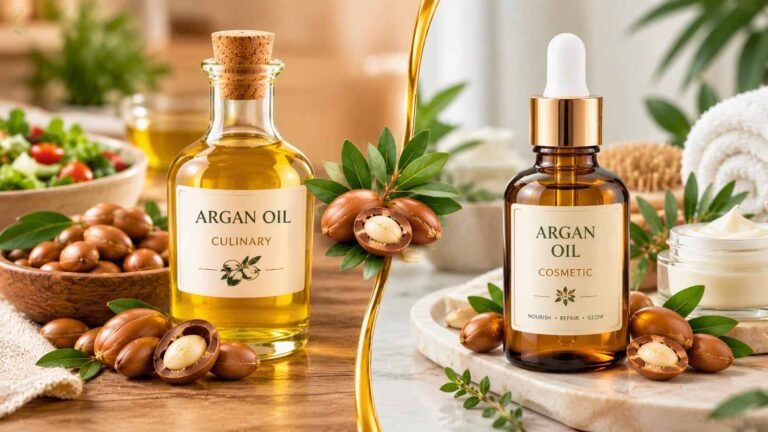
One more distinction is often missed entirely: cosmetic and culinary argan oil are not interchangeable, even though both come from argan kernels. Culinary oil is typically roasted for food use, while cosmetic oil is produced for skin and hair. If you are shopping for a hair product, make sure the bottle in your hand is a cosmetic product. Our comparison of culinary argan oil versus cosmetic argan oil explains that difference in full.
Matching a Brand Type to Your Hair Type
Hair type is the great simplifier in any comparison of argan oil brands, because it narrows the field faster than price or popularity ever will. Fine hair generally suits lighter formulas and smaller amounts, applied mainly to the mid-lengths and ends rather than the roots, where heaviness shows first. Thick, coarse, or curly hair can usually handle richer oils and more generous amounts. Damaged or chemically treated hair sits in between: it needs real conditioning, but not a formula that adds to existing build-up.
Think in terms of experiments rather than commitments. Start with less than you think you need, and build up over several uses. Note how your hair feels not just on the day you apply the oil, but the next day and after your next wash: does it stay soft or turn limp, does frizz stay controlled, does detangling get easier? Those observations, made over a week or two, tell you more about fit than any review can.
Price and Value: What You Are Actually Paying For
Argan oil brands span a wide price range, but price does not map neatly onto quality. Part of a premium price is sourcing and processing: carefully pressed Moroccan oil with certification and traceability costs more to produce than oil from bulk suppliers with less transparency. Part is formulation: a treatment with conditioning agents and heat protection costs more to develop than a single-ingredient oil. And part, honestly, is branding, packaging, and distribution, which have nothing to do with how your hair will look.
The useful question is not whether a brand is expensive or cheap, but what the price is buying. A budget bottle that is genuinely pure, cold-pressed, and well packaged can be excellent value, while a premium bottle that is mostly other ingredients can be poor value despite its price. Conversely, a premium treatment that solves a real problem for you may be worth every penny, while a cheap oil that sits unused because it feels too heavy is wasted money at any price.
To compare value fairly, work out the cost per use: divide the price by the number of uses you realistically get, based on how much you actually apply. A bottle with a pump or dropper that dispenses exactly what you need is worth more than one that pours too much every time, however similar the sticker price.
Common Mistakes When Choosing an Argan Oil Brand
The most common mistake is buying on the front of the bottle alone. Words like Moroccan, gold, luxury, and pure are used very differently by different brands, so always turn the bottle around and read the ingredient list before deciding. The second mistake is using too much, especially with pure oils: a few drops go a long way, and over-application is the usual cause of the greasy, weighed-down feeling that puts people off argan oil entirely.
A third mistake is judging a product after a single use. Hair responds over days, not minutes, so give any new brand at least a week of normal use before deciding, unless it irritates your skin or scalp, in which case stop at once. A fourth mistake is layering oil over heavy styling products without ever clarifying: residues build up, and even a good oil will then sit on top of the build-up rather than reaching the hair. If your hair starts to feel dull or coated, the answer may be a clarifying wash, not a new brand.
A final mistake is ignoring storage: keep the bottle closed, away from sunlight and heat, and use it within the period suggested on the packaging.
Frequently Asked Questions About Argan Oil Brands
Is a more expensive argan oil brand always better?
No. Price reflects sourcing, formulation, branding, and distribution as well as quality, and a higher price does not guarantee a better result for your hair type. Use the label audit in this guide, compare cost per use rather than cost per bottle, and judge by how your hair responds over a week or two.
Should I buy a pure argan oil or a styling treatment?
Choose a pure oil if you want a single ingredient, maximum versatility, and control over how much you use. Choose a styling treatment if you want a lighter, ready-made formula for daily styling. Your hair type and routine matter more than the category itself.
How do I know if an argan oil brand is genuine?
Read the ingredient list, look for cold-pressed and unrefined wording on pure oils, check that the origin is stated plainly, and treat certification claims with care: a recognised certification means more than an unverified badge. Dark glass, a pump or dropper, and sensible storage guidance are all good signs.
Can I use the same argan oil brand for hair and skin?
Pure argan oils are often used for both, but always follow the directions on the bottle you buy, and patch-test first if you have sensitive skin. Styling treatments are formulated for hair and should not be assumed suitable for skin.
What if a brand I like is not reviewed on this site?
That is exactly what the label audit is for. Run through the five checks, compare the bottle with the pure-versus-treatment framework in this guide, and judge it by your hair’s response over a week or two. A brand does not need to appear in a roundup to be a good choice.
Where to Go From Here
Use this roundup as a starting point, not a finish line. For detail on a specific brand, read the full reviews linked above: the Brillare argan oil review and the Redken All Soft Argan-6 Oil review. If you are still narrowing down the field, our best argan oil for hair guide is the natural next step, and our argan oil shampoo page is useful if you are building a wider routine around the oil.
And if you are torn between argan and another oil entirely, do not force the decision. Read our amla oil versus argan oil comparison and explore the amla brand pages for Dabur Amla Oil, Bio Amla Hair Oil, and Brahmi Amla Oil. The strongest choice among argan oil brands is rarely the most popular or most expensive bottle. It is the one whose label checks out, whose formula type matches your hair, and whose results hold up after a week of real use.