Amla Oil: The Complete Guide
Amla oil is one of the most widely used traditional hair oils in the world, and it is also one of the most misunderstood. Made from the Indian gooseberry, known as amla, this oil has been part of hair care routines for generations, yet shoppers today face a confusing shelf: pure infused oils, well-known commercial blends, herbal combinations, and products that carry the amla name but contain very little of the fruit itself. This guide to amla oil brings the whole picture together in one place. It explains what amla oil is, what it may do for hair and scalp health, how to use it without weighing hair down, and where to go next for a deeper look at a single topic. Where a subject already has a full guide on this site, this overview gives you a short verdict and points you there, rather than repeating the whole article.
One honest note runs through everything that follows. Amla oil is a cosmetic hair care product, not a medical treatment. Traditional use is long and well documented, and laboratory research on amla extracts is genuinely interesting, but large, long-term human trials on amla oil itself remain limited. That means the sensible way to judge it is the same way you would judge any hair oil: understand what it can plausibly do, use it consistently and correctly for several weeks, watch how your own hair responds, and stop if your scalp reacts badly. Used that way, amla oil is a low-risk, affordable addition to a routine, and for many people it becomes a long-term staple.
What Is Amla Oil?
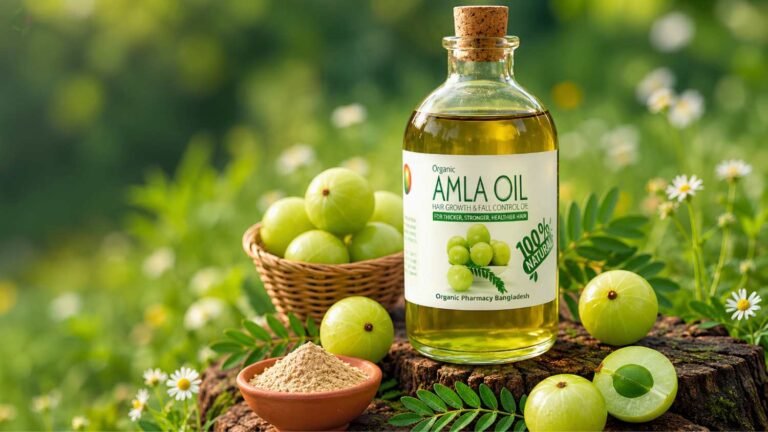
Amla oil is typically made by infusing dried amla fruit, or amla extract, into a carrier oil such as coconut oil or sesame oil, then straining the mixture. Some versions are made by soaking the fruit in oil for days before gentle heating, while others use a concentrated extract blended into a base oil. The result is an oil that carries the fruit’s well-known antioxidant compounds, including vitamin C and a family of plant polyphenols, in a form that can be massaged into the scalp and smoothed over the lengths of the hair. If you want the full background on the fruit behind the oil, our guide to the Indian gooseberry and its traditional uses is a good starting point.
The important thing to understand is that not every bottle labelled amla oil is the same product. Some are simple infusions with a short ingredient list, others are commercial blends built around mineral oil or other carriers with amla extract added, and still others combine amla with herbs such as brahmi. None of these is automatically better or worse, but they behave differently on the hair, and the label is the only reliable way to tell them apart. Later in this guide, the section on reading labels walks through exactly what to look for, so you can match the bottle in your hand to the result you actually want.
Amla oil is also part of a wider family of amla-based hair care. The same fruit appears as a powder, as a juice, and as an ingredient in shampoos and masks, and each form suits a different routine. Readers who are weighing the two most common home forms will find a direct comparison in our guide to amla powder versus amla oil for hair, while those curious about the powdered form on its own can read about what amla powder is and how it is used.
Amla Oil Benefits at a Glance
Most of the claimed benefits of amla oil fall into four groups: scalp comfort, hair strength and breakage, shine and manageability, and support for natural hair colour. The antioxidant content of amla is the common thread. Oxidative stress, the damage caused by everyday exposure to sunlight, pollution, and heat styling, affects both the scalp and the hair fibre, and antioxidants are thought to help counter it. Vitamin C also plays a role in collagen production in the skin, which is one reason amla oil is often described as a scalp-nourishing oil rather than simply a conditioning one.
For a full, benefit-by-benefit breakdown, read our guide to the benefits of amla oil. In short, the realistic expectation is this: amla oil may help keep the scalp comfortable and balanced, may reduce breakage by keeping hair more flexible and less dry, may add shine by smoothing the outer cuticle layer, and may support the scalp environment that healthy-looking hair grows from. What it should not be expected to do is regrow hair that has been lost to genetics, reverse established greying, or transform hair texture overnight. Those stronger claims appear often in marketing, but the evidence does not support them, and this site does not repeat them as fact.
Amla Oil for Hair: Strength, Shine and Scalp Comfort
This is the core use of amla oil, and it is where most readers will notice the clearest difference. Hair that is dry, rough, or prone to snapping often looks and feels better after regular oiling, not because the oil changes the hair’s structure from within, but because it reduces friction, seals in moisture after washing, and keeps the lengths more supple between washes. Amla oil used as a pre-wash treatment, massaged into the scalp and smoothed over the ends and left for thirty minutes to a few hours before shampooing, is the classic method, and it remains the most practical one for most people.
Our dedicated guide to amla oil for hair covers application methods, frequency, and hair-type differences in full, and readers with a specific hair background may also want the guide to amla oil for American hair, which looks at how the oil fits routines built around different textures and climates. A useful rule of thumb from both guides: start with a small amount, focus on the scalp and the driest ends rather than saturating the whole head, and shampoo thoroughly afterwards. Hair that feels coated or limp after oiling usually needs less oil or a lighter application, not a different product.
Scalp comfort deserves a mention of its own. A dry, tight, or flaky scalp often improves when it is massaged regularly with a gentle oil, partly because massage itself increases blood flow to the skin and partly because the oil helps the scalp barrier hold on to moisture. Amla oil is frequently chosen for this purpose because it is generally light, absorbs reasonably well, and does not carry the strong scent of some herbal oils. If flaking or itching persists, worsens, or comes with redness or soreness, that is a sign to stop and consider whether a skin condition needs professional advice rather than more oil.
Amla Oil for Grey Hair: What to Expect Realistically
Grey hair is one of the topics where tradition and evidence pull in different directions, so it helps to be precise. In Ayurvedic tradition, amla has long been associated with maintaining natural hair colour, and the antioxidant explanation is plausible: pigment-producing cells in the follicle are sensitive to oxidative stress, and protecting them could, in theory, help preserve colour for longer. What has not been shown in strong human studies is that amla oil can restore colour to hair that has already turned grey, or meaningfully delay greying in a predictable way for any individual.
The verdict, then, is measured. If your goal is general hair health and you happen to be concerned about early greying, amla oil is a reasonable, low-risk part of a routine, and you can read the full discussion in our guide to amla oil for grey hair. If your goal is specifically to cover or reverse grey hair, oil alone is unlikely to satisfy you, and you would be better served by honest expectations and, if you wish, colour products designed for that purpose. Anyone selling amla oil as a guaranteed anti-grey treatment is overstating the evidence.
Amla Oil for Hair Growth: Reading the Evidence Carefully
Hair growth is the claim that draws most people to amla oil, and it is also the claim that needs the most careful reading. Laboratory studies have found that amla extracts can inhibit an enzyme called 5-alpha reductase, which is involved in producing dihydrotestosterone, a hormone linked to pattern hair loss. Animal studies have also reported faster hair regrowth with certain herbal mixtures containing amla. These findings are real and interesting, but they are a long way from proof that rubbing amla oil on the scalp will grow new hair in humans, because laboratory and animal results often do not translate directly, and the concentrations and delivery methods in studies differ from a home oiling routine.
What can be said with more confidence is indirect: by supporting scalp health, reducing breakage, and keeping existing hair in better condition, amla oil may help you retain more of the length you grow, which many people experience as thicker or longer-looking hair over time. That distinction, between growing new hair and keeping the hair you have, matters, and it is the honest frame used throughout our guide to amla oil for hair growth. If you are experiencing sudden, patchy, or rapid hair loss, or loss accompanied by scalp pain, scaling, or other symptoms, see a clinician rather than relying on any oil, because several treatable conditions present that way.
How to Use Amla Oil Without Build-Up
Most complaints about amla oil have little to do with amla itself and everything to do with amount, timing, and washing. Too much oil, left on too long, or washed out with too gentle a shampoo leaves a coated feeling and can make hair look flat or dull. The method that works for most people is simple: warm a small pool of oil between your palms, part the hair in sections, massage it into the scalp with your fingertips for a few minutes, smooth what remains over the mid-lengths and ends, and leave it for at least thirty minutes before washing. One to two sessions a week is enough for most routines, and daily heavy oiling is rarely necessary.
Our step-by-step guide to how to use amla oil covers variations for dry, oily, curly, and fine hair, including how to adjust the amount and whether to apply to damp or dry hair. Two practical tips recur across reader questions. First, a clarifying wash every couple of weeks helps prevent the gradual build-up that makes any oil feel heavy over time. Second, patch testing matters: dab a little oil on the inside of your forearm, wait twenty-four hours, and only proceed to a full scalp application if there is no redness or itching. That single habit prevents most bad first experiences with a new product.
Amla Oil for Skin and Body Care
Although hair is its main use, amla oil is also used on the skin, and this is an area where expectations should stay modest. As a body or massage oil, it is light, absorbs without a heavy residue, and suits people who prefer unscented or mildly herbal products. Its antioxidant content is sometimes cited for skin, but cosmetic oils are not a substitute for sun protection, moisturizers formulated for the face, or treatment for skin conditions. If you have sensitive or reactive skin, the same patch-test rule applies, and facial use deserves extra caution, since the skin on the face reacts more readily than the scalp.
Readers interested in this side of amla oil will find the fuller picture in our guide to amla oil for skin, which covers body use, massage, and what to avoid on delicate skin. A related topic worth knowing is that amla itself is consumed as food and juice in many households, and our guide to amla juice benefits and uses explains that side separately. Eating amla and applying amla oil are different things, and one is not a substitute for the other.
Amla Oil vs Coconut Oil and Amla Oil vs Argan Oil
Comparisons are useful only when they answer a real choice, and most readers face one of two. The first is amla oil versus plain coconut oil, which matters because many amla oils use coconut oil as their base. In that case the question is really whether the amla infusion adds anything beyond the coconut oil itself, and the answer depends on the product: a genuine infusion brings amla’s antioxidant compounds along with coconut oil’s conditioning properties, while a lightly scented blend may differ very little. Our head-to-head guide to amla oil versus coconut oil works through that distinction in detail.
The second common comparison is amla oil versus argan oil, which suits a different routine. Argan oil is typically lighter, used in smaller amounts as a finishing or leave-in oil, and often chosen for shine and frizz control, while amla oil is more often used as a pre-wash scalp treatment in larger amounts. Neither is universally better; the right choice depends on whether your main goal is scalp care, length conditioning, or a light finishing step. That trade-off is mapped in our guide to amla oil versus argan oil, and readers comparing oils more broadly may also enjoy our guide to argan oil versus other oils for context on where amla sits among its rivals.
Amla Oil Labels Decoded: Pure, Commercial and Herbal Blends
Here is the angle most amla oil guides skip, and it is the one that will save you the most money and disappointment: learning to read the bottle before you buy. Start with the ingredient list, not the front label. A genuine infused amla oil will list amla, often as Phyllanthus emblica or Emblica officinalis, alongside a named carrier oil such as coconut or sesame oil, near the top of the list. If amla extract appears near the end of a long list dominated by mineral oil, the product may still condition hair, but you should not expect the same herbal character as a true infusion, and you should judge it on how your hair feels rather than on the amla name.
Next, look at the base oil, because the base decides how the product behaves. Coconut-based amla oils tend to feel richer and suit dry or coarse hair, sesame-based versions are traditional in Ayurvedic practice and feel slightly lighter, and mineral-oil-based commercial blends tend to sit more on the surface, which some people like for shine and others find heavy. There is no single correct base, only a base that matches your hair. Fine or easily weighed-down hair generally does better with a lighter base and a smaller amount, while thick, dry hair can handle a richer one.
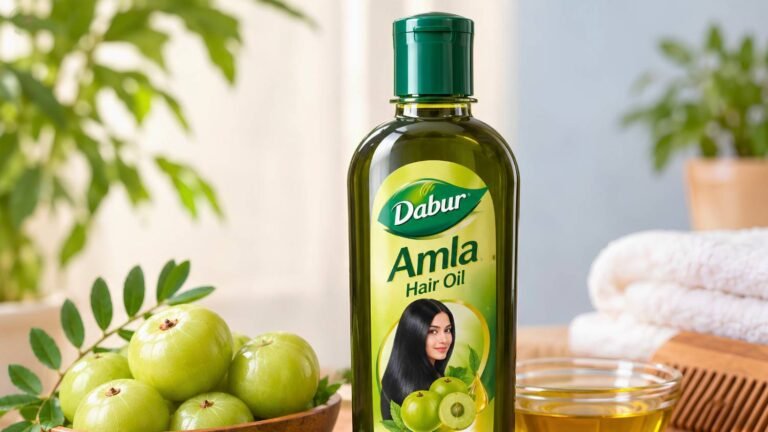
Finally, understand the named blends, because they are genuinely different products. Dabur amla oil is the most widely sold commercial amla oil, and our guides to Dabur amla hair oil uses and Dabur Amla Gold hair oil benefits explain how its formula and use differ from a simple infusion. Bio amla hair oil and Brahmi amla oil combine amla with other herbal ingredients, brahmi in the latter case, and suit readers who want a multi-herb product rather than amla alone. If you prefer the simplest possible product, look for the guides to pure amla oil and organic amla oil for hair, which explain what those labels do and do not guarantee. Pure on a label is a marketing term unless it is backed by certification, so the ingredient list remains your best guide.
Amla Oil Side Effects and Safety Checks
Amla oil is generally well tolerated, but a few cautions belong in any complete guide. Allergic reactions are uncommon yet possible, and they are the reason patch testing is repeated so often in this guide. Some people notice scalp itching or flaking when oil is used too frequently or not washed out fully, which is usually a build-up problem rather than an allergy, and it typically resolves when frequency drops and washing improves. Rare immune-related skin reactions to amla have been reported in medical literature, which is another reason to stop use and seek advice if you develop unusual pigmentation changes, persistent irritation, or swelling after starting a new product.
Two further habits keep use safe. First, keep oil away from the eyes, and wash your hands after application. Second, store the bottle away from heat and sunlight and discard it if the smell turns rancid, since oxidized oils are more likely to irritate skin. Our full safety guide to amla oil side effects, hair loss and allergy covers these points in depth, including the important distinction between shedding that coincides with starting an oil and shedding caused by it. Hair sheds every day as part of its normal cycle, so a few extra hairs noticed after a massage are not, on their own, evidence that the oil is causing loss.
Amla Oil: Which Guide Should You Read Next?
If you arrived here looking for one answer, this map will get you there faster than searching the site. Start with the goal that matches yours, read that guide in full, and return here only if you want the wider picture. For overall benefits, read the benefits of amla oil. For hair in general, read amla oil for hair. For growth questions, read amla oil for hair growth. For grey hair, read amla oil for grey hair. For application, read how to use amla oil. For skin, read amla oil for skin. For choosing a bottle, compare pure amla oil with Dabur amla oil, Bio amla hair oil, and Brahmi amla oil. For comparisons, read amla oil versus coconut oil or amla oil versus argan oil. For safety, read amla oil side effects and allergy. And for the powder alternative, read amla powder versus amla oil and amla powder for hair growth and skin.
One pattern is worth noticing as you explore. The guides that help most are the ones that match your specific situation, not the ones that promise the most. A reader with fine hair and an oily scalp needs different advice from a reader with thick, dry, curly hair, even though both are asking about the same oil. That is why this hub exists: to stop you reading a generic article and instead send you, in one click, to the guide written for your hair, your goal, and your bottle.
Final Verdict on Amla Oil
Amla oil earns its place in a hair care routine on modest, believable grounds. It is an affordable, traditional scalp and conditioning oil with interesting antioxidant chemistry, a long history of use, and a good safety record when patch tested and washed out properly. It is most convincing as a pre-wash treatment for scalp comfort, breakage reduction, and shine, and least convincing as a cure for hair loss or greying, where the evidence is preliminary and the marketing often runs ahead of it. Buy it by reading the ingredient list, use it in small amounts once or twice a week, give it a month of consistent use before judging it, and let your own hair, not a label’s promise, decide whether it stays in your routine.